

Hearing testing at work: Health surveillance under the noise regulations
The UK’s Control of Noise at Work Regulations 2005 say that anyone who is ‘regularly and frequently’ exposed to a noise risk level of over 85 dB(A) in a noise assessment, without taking the effect of hearing protection into account, should then be included an ongoing health surveillance programme. What that means is an ongoing programme of regular on-site hearing tests.
Video: what is hearing health surveillance
If you have had a noise assessment done, one of the common outcomes is identifying people who fall into the need for hearing health surveillance, a slightly convoluted way of saying a hearing testing programme at work. Health surveillance can be a little complex if you are new to it so this guide covers the key parts.
This video is an overview of what a hearing health surveillance programme covers, from how it works, what the results categories are, doing it yourself vs getting someone in, the need for medical oversight and even managing Agency staff.
For those who prefer reading to videos, all these elements are covered below.
Hearing health surveillance overview
Who should be included in a hearing testing programme?

A good noise assessment should identify this clearly for you and list the job functions which should be included in any health surveillance needs.
The basis for this is what the HSE say in L108 Controlling Noise at Work. The main proviso is that anyone who is ‘regularly and frequently’ exposed to average daily noise levels over the 85 dB(A) point or peak levels of 137 dB(C) or above is included in health surveillance.
That ‘regularly and frequently’ means hearing testing programmes don’t automatically apply to every single person who goes into the higher noise risk area. For example, if an office person occasionally goes in to speak to someone and they need to wear hearing protection for that, they still do not ‘regularly and frequently’ exceed the daily exposure limits so would fall outside of the need for hearing testing.
There is more information on this here: Who to include in hearing health surveillance.
If you use Agency staff then this can be a little more nuanced so have a look at the specific article on who is responsible for hearing tests in Agency staff.
Health screening vs health surveillance
The two terms are used interchangeably by normal people but they do have slightly different meanings.
Health screening means undertaking a hearing test and looking how that person compares to normal results for their age and sex.
Health surveillance is that but with medical oversight and importantly as part of an ongoing programme.
The Noise Regs require health surveillance, so mean it is an ongoing programme, not a one-off, and with some form of medical oversight.
As a side note, I have seen some companies using a self-completed questionnaire asking employees about any hearing issues and then considering this to be ‘health surveillance’ but this is not sufficient. Health Surveillance includes an actual hearing test and with someone with sufficient medical knowledge of the issues overseeing it.
What will on-site hearing health surveillance entail?
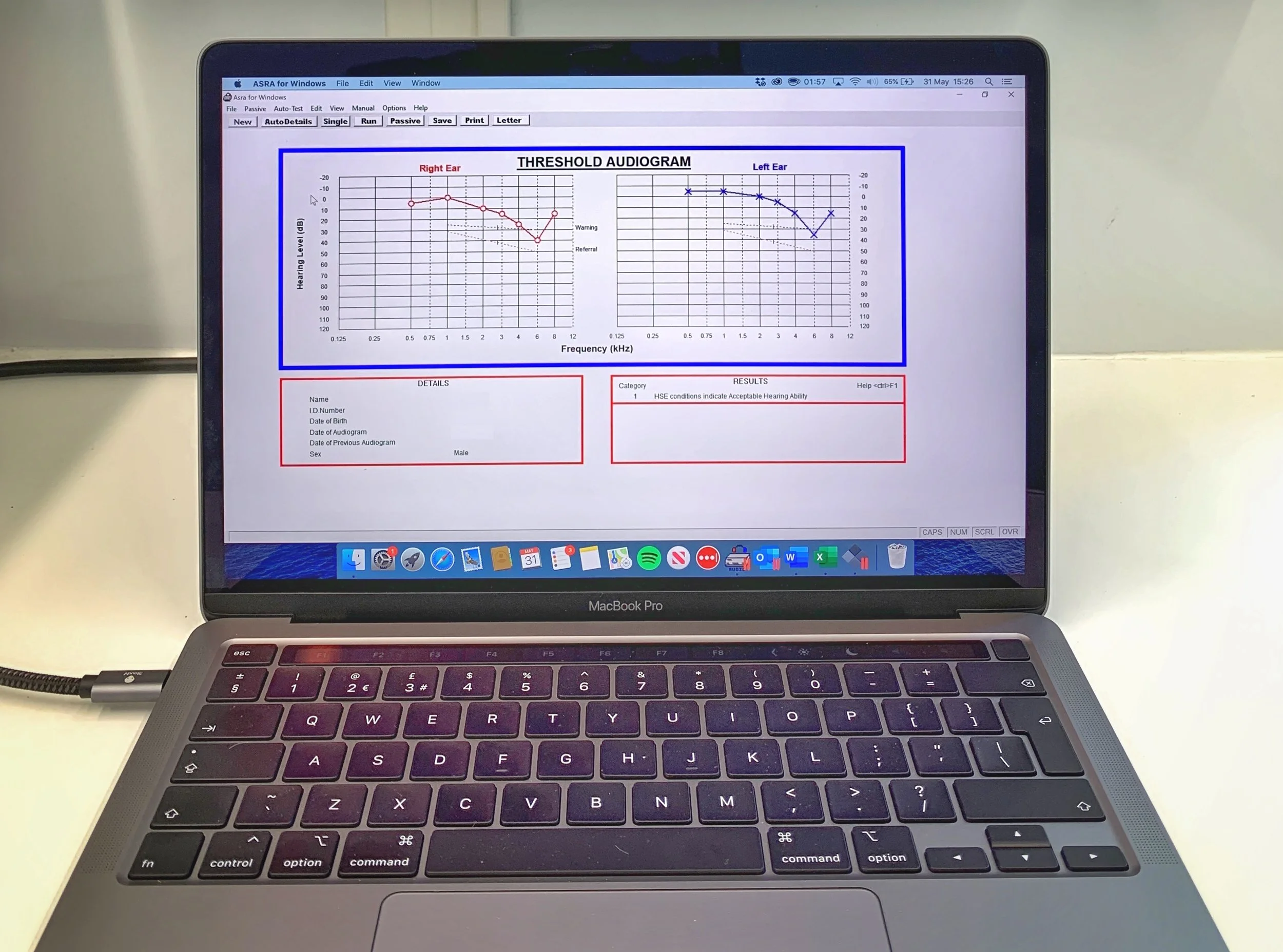
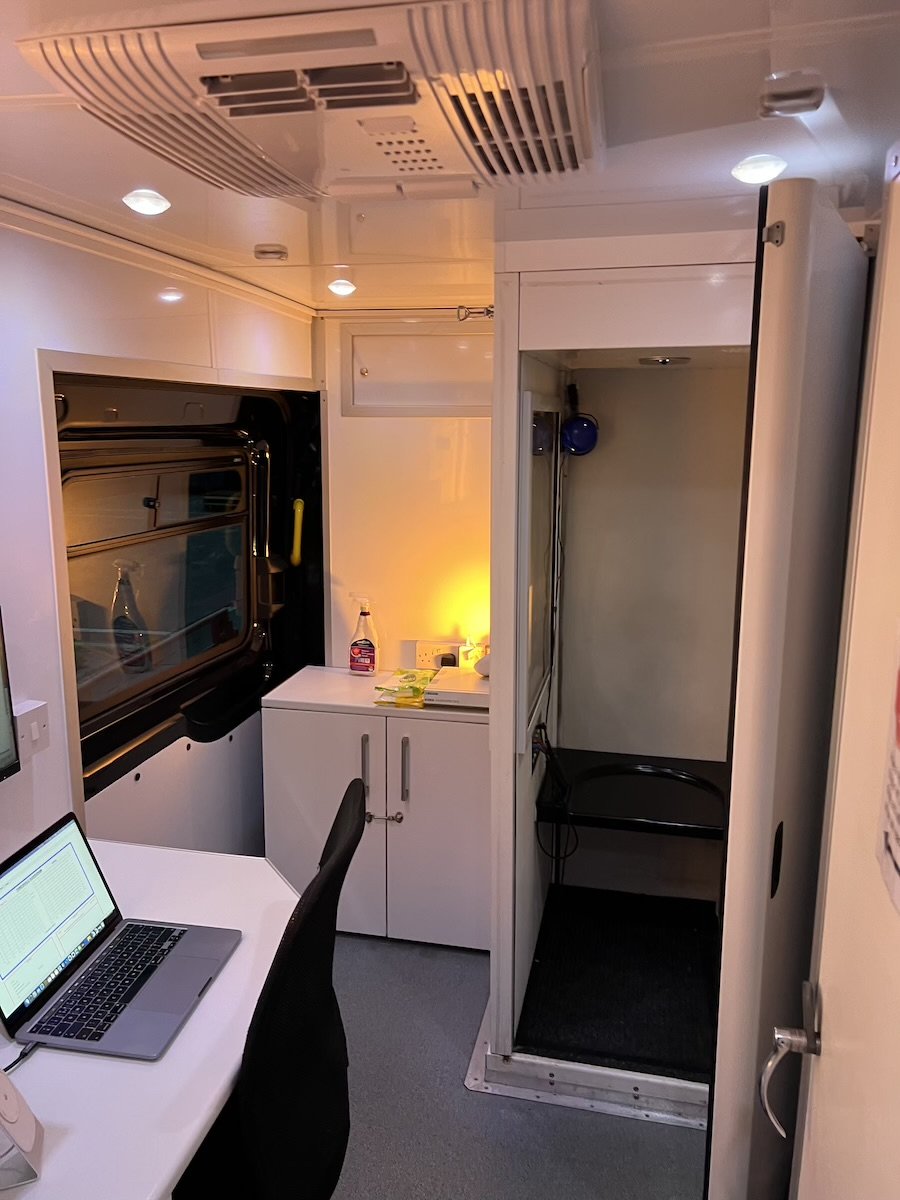
Someone will come to your site, usually in a mobile clinic, and do the testing there for you. Your people go to their van, go through a hearing health history review and wider health review if it has the possibility of impacting on hearing, have an otoscopic examination (a visual check of the ear drum) and then have the ‘hear beep press button’ audiometry test. The results are overseen by an occupational health nurse.
The client then gets a report of who is OK and who needs any follow-up action. That may be a further review by an occupational health physician, or a recommendation to see their own GP if the issue raised is nothing to do with noise or work but would benefit from a follow-up.
Pitfalls to watch out for in hearing health surveillance
Self-testing hearing testing kits
There are companies out there offering to rent employers a ‘hearing test in a box’ but they are non-compliant with the British Standard for hearing testing or with the British Society of Audiology’s Procedure for Screening Audiometry.
There is no on-site daily verification check (that is different to the annual calibration, this is a check before the start of every session).
There is no otoscopic (visual) examination of the ear so it could be blocked, infected, etc.
People put their own headphones on. It sounds silly but this is a real no-no, people position headphones for comfort rather than ensuring the speaker is placed properly and directly over the ear canals and that can have a big impact on the results.
There is no oversight of the test as it runs and people do get a hearing test wrong, every day, from the random button pressers who are all over the place, to the overly hesitant who end up far worse than they actually are as they need longer to decide they heard it and press the button. (Especially made harder if they have tinnitus).
Everyone gets the same meaningless ‘a Category 2 result means this’ nonsense statement rather than having the result explained in terms of their own medical, occupational noise and social noise exposure history.
Office-based hearing testing
Conducting hearing tests in an office or meeting room, either with a self-test kit or done by a Technician, is often pretty poor.
If you can hear any music, telephones, speech, etc. then the test will be interfered with as those are precisely the tones being tested and can mask them.
Any machinery noise can overwhelm the hearing test tones, or at a lesser level distract people meaning they miss the quieter tones.
Both these can have an impact on the results.
Often companies talk about noise-reducing headsets but they don’t do much and every hearing testing company uses those as standard anyway these days. (To be honest, I always found those big audiocup enclosures to actually be worse in hearing tests, not better - they seemed to create a ‘seashell’ kind of hollow effect and I found it harder to use when testing myself than the plain headset).
High street hearing testing services
These are not sufficient to meet the needs of health surveillance. They typically do not assess the results as specified by the HSE in L108 and have limited access to historical results where tracking trends is an important part of health surveillance. Also, they are not overseen by an Occupational Health specialist and health surveillance is more than just the ‘hear beep press button’ hearing test element. It needs to be done by someone who understands, and is qualified in, occupational risk and categorises the results against the HSE’s specifications in L108.
You cannot use these as a simpler or cheaper way of meeting health surveillance needs.
What the hearing test results categories mean
Hearing tests for work are classified into categories, with the levels being 1, 2 3 and 4. There is also a sub-category of ‘unilateral’.
Category 1
Everything is normal for that person’s age and sex and that there are no signs of possible noise damage. That doesn’t mean their hearing is perfect but that it is where it should be for their age - an older person should have weaker hearing than a younger one and this is taken into account.
Category 2
This means either their hearing is ‘a little weaker than is ideal but OK’, or that their hearing is good but does have some signs of noise damage, however that damage is stable and not deteriorating.
Category 3
This means either their hearing is weaker than it should be for their age and sex, or that it is OK overall but it is the first identification of some damage which is possibly related to noise exposures, or the noise damage has got a little worse since their previous test.
Category 4
The one is different as it is not a level of hearing but is an assessment of ‘rate of change’. Category 4 means their hearing has deteriorated since their previous hearing test, to an extent that it is considered ‘significant’. They could still have good hearing, just that it was even better last time.
Unilateral
This is alongside the main Category, so you may see something like ‘Category 2u’. Unilateral mean the hearing loss is in one ear only. Normally hearing should be well balanced between both ears so a case of one being lower than the other is a potential sign of an issue. That doesn’t automatically mean a serious one, it could be a simple blockage or an infection, but something is affecting one ear.
Which categories are a pass or fail?
Generally, Categories 1 and 2 are a ‘pass’ while Categories 3 and 4 are a ‘fail’ and usually mean some kind of follow-up examination.
More information
I have an article going further into the hearing test Categories here: Categories of hearing test result
Noise Induced Hearing Loss - what the hearing testing is looking for
All these Categories are looking to identify anyone who is showing signs of Noise Induced Hearing Loss (NIHL), what used to be called Industrial Deafness in the old days. (This was changed as the word ‘industrial’ implies a cause whereas in reality a hearing test can identify possible noise damage but as all noise has the same impact on hearing, it cannot definitively identify a cause.)
This page has a demonstration of what hearing loss from noise sounds like: What hearing damage caused by noise sounds like
FAQ: Hearing health surveillance overview
Quick questions and answers on hearing testing at work as part of a noise risk management programme
Can we do one set of hearing tests and then be compliant?
No, ‘health surveillance’ means an ongoing programme, overseen by someone with relevant expertise. Repeat testing is needed as part of what is being assessed is rate of change, not just level of hearing.
Can we (the employer) have all the results data?
The HSE say the employer should have anonymous results only so no, employers cannot see the full audiometry results. As a personal opinion on this, this is very detrimental to individual safety and to the effectiveness of the noise safety programme, but it is what it is. If you get annoyed that your occupational health provider won’t give you person-specific information then it is not their fault.
Can we do hearing tests ourselves in-house?
Yes, you can, provided you have the right training and equipment. You can get training from Amplivox in workplace audiometry, and get an audiometer from Amplivox or GM Instruments, etc. and then make your own arrangements with an Occupational Health Physician for oversight of any ‘fails’. (And in this instance, you can also then have all the results, just to show how nonsensical the HSE’s stance on the previous question is - you are OK to gather exactly the same data if you do it yourself). For all but the largest employers that’s not often a cheaper way to the same result though.
How often should we do hearing tests?
The retesting is roughly:
A person has their first hearing test (counted as Year 1)
They then have another test a year later (counted as Year 2)
If they are Category 1 they are then next due in three years, and as an approximate rule Category 2 are done in two years and Categories 3 and 4 are done in one year.
The HSE specify in L108 that three years is the maximum time (after that changes due to age could mask developing noise issues).
There is another proviso that for people with an issue, the retesting period should be as advised by the occupational health professional overseeing the programme so be aware that it could mean retesting in anything from six weeks to six months for specific people with cause for concern.
I have an article going into this in more detail here: How often does hearing testing have to be done?
Can we just do the hearing tests every two years?
No, ‘health surveillance’ means more than just testing everyone on the same frequency. L108 specifically says that the retesting frequencies should be determined by the result and as recommended by the occupational health professional overseeing them. Simply testing everyone every couple of years is not sufficient.
Is attendance at a hearing test compulsory?
The hearing tests must be provided in working hours and yes, it is equally compulsory for the employee to attend and co-operate with the process. The same ‘weight’ of law which requires an employer to provide the hearing tests also explicitly says that an employee shall both attend and co-operate.
How long does a hearing test take at work?
Different providers work at different speeds and I have seen everything from 10 to 30 minutes per person. Personally from back when I used to do them, 15 minutes is a nice relaxed pace, anything shorter is probably cutting corners.
How can I be told I am Category 1 but my hearing is worse than a mate who is a Category 2?
The important factor is that it is age-related. Someone who is 50 should have worse hearing than someone who is 25 and the standards they are being compared against change with age. This means the 50 year old could have some hearing loss but it is perfectly normal for their age, while the standards for a 25 year old are very high so a Category 2 for them could mean some slight losses, more than is expected for their age, but still very good overall.
Health surveillance seems rather expensive, why?
Sometimes it is indeed wise to be sitting down when you get a quote for hearing testing at work but to be fair to the health surveillance providers, there is a lot going on behind the scenes with it. They need to cover the costs of the person’s salary who is on your site, plus the ongoing equipment costs which I know from my own past experience can be cripplingly expensive both to buy and maintain, (I used to have specially converted vans and you were looking at something like £45k for the van then at least another £30k for all the internal fitting-out and equipment). The HSE are very tight now on things like an employer not having all the actual data which means your provider will be maintaining a software package which is eye-wateringly expensive, plus the hearing tests need to be overseen by a medical professional so there is one person sitting in the van doing the tests, and another elsewhere then going through all the data as well. Most of them also employ their own doctors so the hearing testing is covering equipment, software, a technician’s salary, a nurse salary and ofter a doctor’s costs as well, plus travel time and hotels and fuel. They need to charge quite a chunk just to cover costs, before they even start to make a profit for doing it. They aren’t gouging you, it really is an expensive thing to provide.
Don’t be tempted to turn to things like high street hearing test providers. As mentioned above, they are not compliant with the health surveillance needs so that’s not a cheaper way to get the same thing done.
Can you recommend a health screening provider?
I don’t provide health screening services but if you are looking for someone I recommend Aardvark Occupational Health. They are a GP-owned occupational health provider covering all areas of the UK.
Related guidance on hearing health surveillance programmes