
What do the hearing test result categories mean?
Part of a noise assessment is to determine which people need to be included in a health surveillance programme which is an ongoing series of hearing tests for people exposed to high noise levels.
Key points on hearing test results categories in health surveillance
All results are assigned a Category, 1, 2, 3 or 4.
Categories 1, 2 and 3 are levels of hearing against standards for the person’s age and sex.
Hearing is supposed to get worse as you get older, and that is faster for men than women. The Category 1 doesn’t just mean ‘good hearing’ but means ‘good hearing for where it is supposed to be for your age and sex’.
Category 1 is a pass, Category 2 means it is OK but with some reductions or very stable mild noise damage, while Category 3 means either it is weaker than it should be or there is some possible noise damage present.
Category 4 is different - it is not a level of hearing but is an assessment of rate of change.
Category 3 or 4 with no supporting historical knowledge or other justification usually mean some form of referral needed.
Category 3 does not mean you are ‘deaf’, it just means it is a not as good as it should be. Someone who is Category 3 but is 25 years old could still have far better hearing than someone who is 50 but a Category 1. Age is important.
A common abbreviation you will see is ‘NIHL’, this means ‘noise induced hearing loss’.
The hearing tests are categorised according to criteria set out by the HSE in L108, Controlling Noise at Work (Third Edition) and are:
Hearing test categories as defined in the HSE's L108.
What the Categories mean in hearing testing at work
NIHL and workplace noise
Having an identification of NIHL, noise induced hearing loss, doesn’t mean it has been caused by work, it means some hearing damage caused by possible high noise exposures. That could be work, but as noise damage is permanent it could have been regular time in nightclubs 20 years ago, or a lot a headphone use, etc.
In the old days it was called Industrial Deafness. The ‘industrial’ was dropped as it implies a cause but as all noise has the same impact on hearing, whether it is a loud machine or music, then identifying possible noise damage cannot confirm a cause.
NIHL is common, very common. In a sample I did of over 5,000 hearing test results, the vast majority had some level of NIHL. If you are told you have some noise damage, that doesn’t mean you are deaf or that your hearing is weak, or even that it is weaker than it should be for your age, it is just a statement that there is some damage, probably caused by noise exposure, and the majority of people can show that pattern.
Meaning of a Category 1 hearing test result
Someone with normal hearing for their age.
It doesn’t mean the hearing is perfect as hearing is supposed to get worse with age. Someone who is 25 should indeed have nigh-on perfect hearing to be Category 1, while someone who is 55 could have some fairly chunky reductions but it is still normal for their age and they are still Category 1.
That means a slightly older person may start to notice some occasions when they struggle to hear clearly but they could also still be Category 1 as their hearing is not supposed to be as good as it was.
To be Category 1 there must be no signs of possible noise induced hearing loss (NIHL).
Meaning of a Category 2 hearing test result
This is where it starts to get a little trickier as Category 2 can be either:
If it is their first hearing test, they could be someone who has some reductions in their hearing which are getting towards the lower end of what is acceptable for their age, but it is still a pass. No NIHL can be present.
Or if their second or subsequent test, it can be someone who has good or even excellent hearing overall, but there are also some signs of noise damage present, but the testing is showing it to be stable and not deteriorating.
From experience, for people who have had multiple hearing tests, the majority now fall into Category 2 because they have perfectly fine hearing overall but there are some signs of noise damage, usually from time as a more exuberant youth. Basically this is normal for a lot of people who have lived a little.
Meaning of a Category 3 hearing test result
There are three ways to end up as Category 3:
Someone who has hearing which is weaker overall than it should be for their age.
Someone who has otherwise good or even very good hearing, but they have signs of noise damage present which have not been identified before as this is their first hearing test with their employer.
If it is a first identification of the possible noise damage the HSE say they have to be Category 3 no matter how good their hearing overall.
(Frankly this is madness - I have seen many people who have hearing which is superb but they have a bit of NIHL from some clubbing decades ago but as it is their first test they have to be Category 3. Or maybe I am just old and grumpy.)
They have signs of noise damage which is getting worse compared to previous years.
Meaning of a Category 4 hearing test result
The HSE were really not helpful with their naming of this one as Category 4 is very different to the others. The others are all a level of hearing against expectation for their age or where noise damage is present, but Category 4 means they have a significant deterioration compared to previous years.
Category 4 is therefore a rate of change, not a level of hearing.
Someone can be Category 4 but still have excellent hearing, just that it was even better last time. Category 4 means the hearing has changed more than it should so the question is then whether there are any other justifications for it at the time such as an ear infection, cold, etc. or is the pattern consistent with ongoing noise-related losses.
Meaning of a Unilateral hearing loss category
If you have had a hearing test you may also see a result of ‘unilateral’ alongside the Category, usually something like ‘Category 2u’.
Unilateral means the hearing in one ear is weaker than the other.
Hearing should be similar in both ears so having one lower than the other is a possible sign of a problem. The most common causes are simply a blocked ear canal or an infection in one ear although if you Google unilateral hearing loss, like googling anything medical, cancer always pops up somewhere and as with everything else, that can also be the case here.
From a noise perspective, there are some noises which can hit one ear more than another and the common ones are shooting and being a DJ. In the old pre-aircon days it was also common for van and HGV drivers to have one ear showing more losses than the other from spending hours every day driving with the window open, giving a significant noise exposure to one ear, but that’s less common now.
It is pretty uncommon for occupational noise to cause NIHL in one ear only and therefore cause a unilateral classification, purely as most industrial noise hits both ears pretty much equally.
FAQ: Hearing test results categories in health surveillance
I have been told I am a Category 3, does that mean I am going deaf?
No, it just means the hearing is not meeting the standard expected for your age and sex. There can be a very large difference between that and being ‘deaf’. If it is not caused by noise then there is a good chance it will recover again - while hearing loss due to noise is a one-way process, other causes do come and go.
I was a Category 3 in the past and am now a Category 2, that must mean the hearing test was rubbish as hearing doesn’t improve?
It is perfectly possible to increase in Category as hearing can indeed improve sometimes.
For example, a temporary issue like a slight cold could have pushed it down to a Category 3 last time but now you are fine and it is a Category 2.
Hearing is also not fixed and changes with things like what noise exposure you’ve had that day, how tired someone is, or for some people even how much caffeine they’ve had that day.
Another reason could be that your hearing has remained exactly the same but you have got older and expectations have crossed a threshold - if you were at the top end of a Category 3 before in a previous test, now you are a little older the standard the result is being compared to may have dropped a little meaning you now come in as a Category 2 with the exact same result.
It doesn’t mean the hearing test was faulty.
I have been told I am Category 1 but I still struggle to hear conversations in loud places, why?
Category 1 means your hearing is good for your age, but if you have a few decades under your belt then that target already includes a degree of high frequency loss. That can mean your hearing is fine for your age but you do still have some issues hearing speech around high noises. Sadly we don’t all keep a teenager’s hearing as we get older.
There is also a more complicated answer - there are three nerves going from the ear to the brain and one carries very loud sounds. Excess noise can damage that ‘loud sound nerve’ meaning your hearing at low and mid-volume is fine as those nerves are good, but loud noises do struggle as that one has some damage. The sound of someone talking loudly in a loud environment will be carried by that high volume nerve, which is now damaged so you may struggle a bit. A hearing test measures the quietest sounds you hear so you could be a perfect Category 1 on that but still struggle with loud sounds because of this. A hearing test does not measure how effective that ‘loud sound nerve’ is.
(This is relatively new science by the way, from the Harvard School of Medicine, and at the time of writing only came to light within the last couple of years).
You keep mentioning sex, why does someone’s sex matter?
In a hearing test for health surveillance, the person’s result is compared to expected normal results. As hearing gets worse with age we take age into account. As well as age, men lose their hearing faster than women. If you took the result for a male in his 50s and compared it to the standard for a female in her 50s, he could class as a ‘fail’ while being perfectly fine against the male standards. The ‘normal’ standard for a female’s hearing is higher than a male’s as people get older.
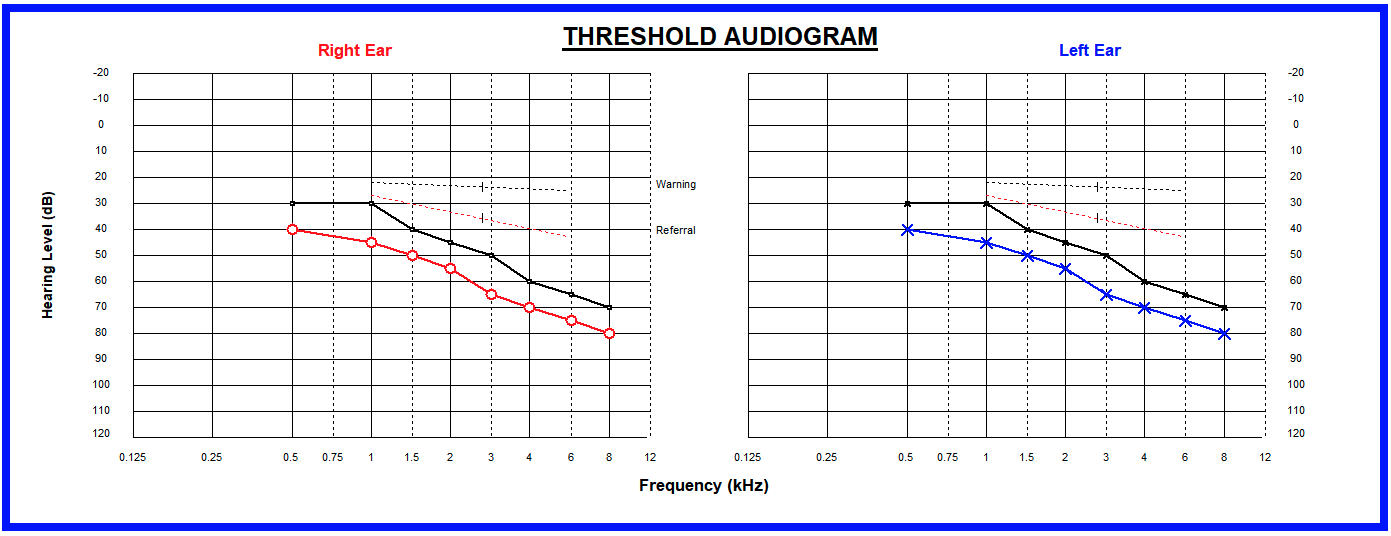
For interest, these are the very lowest limits of a Category 2 result for someone who is 65 years old. The black line is the female limit, the red and blue lines are the male limits.
Tact can be needed here as birth sex is what matters. Back when I did hearing tests I would go with whatever gender the person identified as and if they passed then absolutely fine - what we are most interested in is noise damage or deterioration. If they failed then I would change the sex classification to see if that made a difference and in a small number of cases it did. Explaining that with respect was always greeted with interest rather than becoming a problem.
More information on hearing testing at work



Article last reviewed May 2026