
How long should a noise assessment take?
This a common and understandable question that people looking for a noise assessment often ask - how long will it take.
Key points: How long a noise assessment will take
Although the noise exposure limits are for an eight hour day, that doesn’t mean the noise has to be measured for eight hours.
You measure for as long as is needed to get a stable result covering all the cycles of the work.
If the level is stable after ten minutes then it doesn’t matter if you measure for another hour or eight hours, the result will be exactly the same.
The approach tends to be to measure jobs in parts and then add the various bits together to make up a working day.
A noise assessment’s time is not determined by clock-time on site but by number of measurements needed and made.
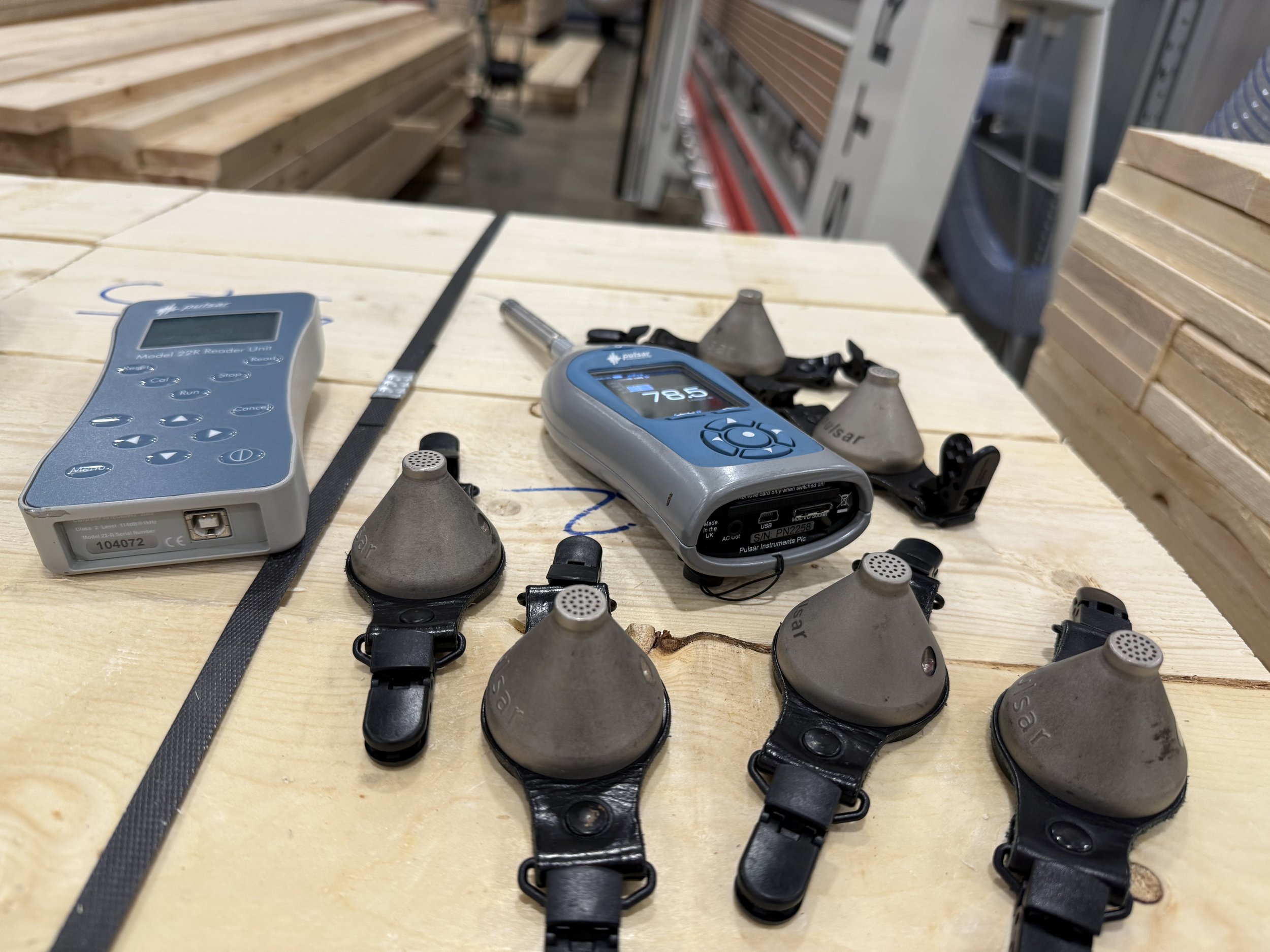
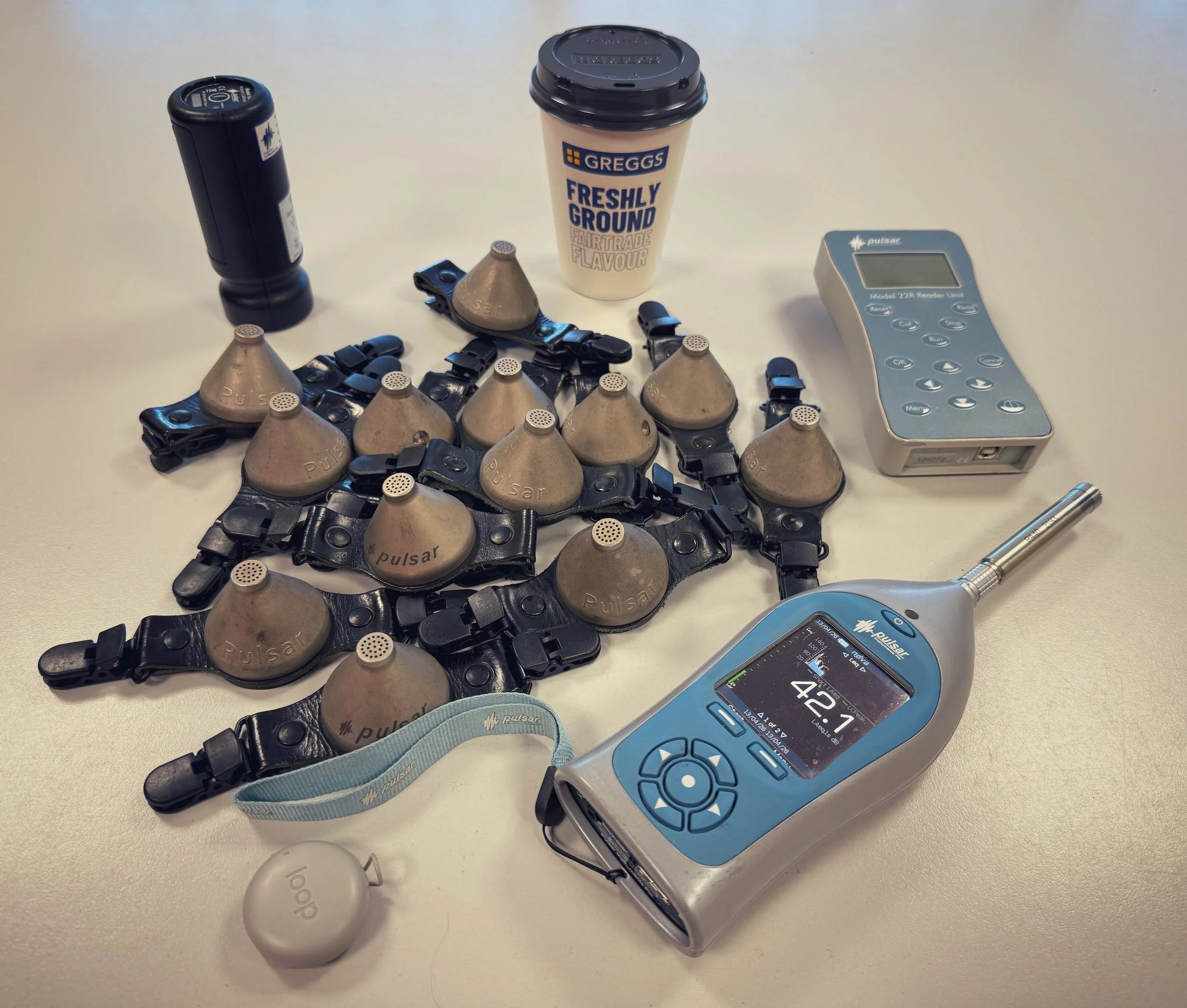
An assessor with three noise meters may need two days to cover a site. I have 14 noise meters which means I can do more actual noise measurement in two hours than someone with three meters does in two days.
When looking at quotes, a longer time on the site does not equate to an increased amount of noise data obtained. Number of meters is key.
Eight hour daily averages in noise assessments
The Control of Noise at Work Regulations 2005 talk about an employer having a ‘reasonable estimate’ of the daily noise exposure levels for employees and the limits are based on an average level across an eight hour working day. But, that doesn’t mean a noise assessment has to last for eight hours.
To take two scenarios:
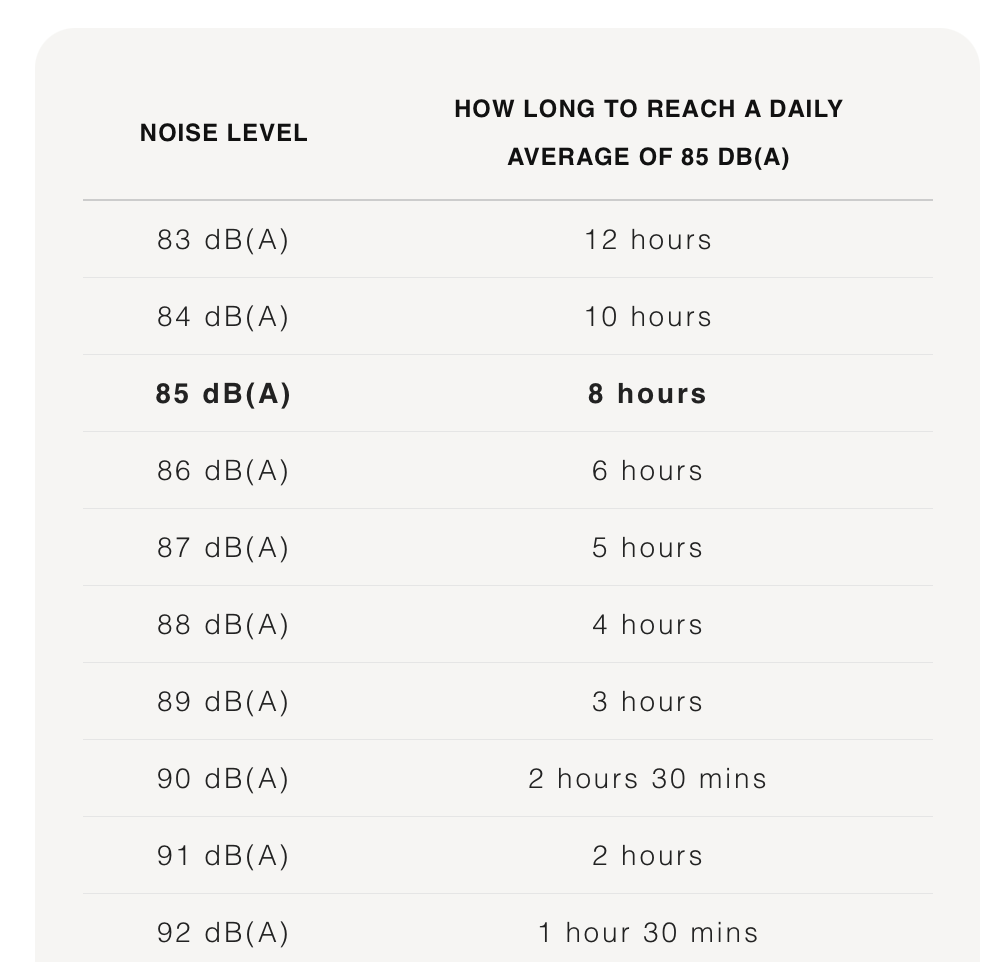
Bob works on a press, doing the same thing roughly every 30 seconds and does that all day. If we measure for a few minutes the noise reading will settle at 91 dB(A). From that point on it doesn’t matter if you measure for five minutes or for his entire shift, the result will be exactly the same.
Steve works on the press for three hours and then on a robotic welder for five hours. If you measure the press and the welder separately you will get a noise reading for each. Then some maths can add the two exposures together, including their respective exposure times, and give you an eight hour daily average figure.
In both, you don’t need to measure for eight hours to get a daily noise exposure figure.
Once a reading has settled for a job, measuring for longer doesn’t change the result at all. Measuring like this is not a short-cut, it is the normal way of assessing noise exposures and the HSE include a process for doing it in L108.
This is also important when looking at things like overtime or longer shifts where the exposure time is different to the standard eight hours. If people occasionally do a couple hours of overtime you don’t then need to do a ten hour measurement as well as an eight hour one, you can work out a ten hour exposure from the noise level measured for the job itself.
Another factor can be sites where there is no daily routine and tool use changes every day - more on this below.
Number of noise meters makes a big difference to how much time is needed.
Back when I started doing noise assessments, most noise assessments were done with one noise meter, or maybe two or three if someone had gone to town buying them. Now however, as a noise assessment specialist I have invested heavily in a lot of equipment and am using up to 14 noise meters at once. That means I can gather the equivalent of 14 hours of data every hour, the same as would have taken almost two days to do in the past with one noise meter.
For smaller companies I can often measure the entire site at once rather than bits at a time, while still gathering more technical data than would have been obtained in entire days or two days in the past.
For larger companies I can usually cover entire departments or several production areas at once.
Consider ‘measuring hours’ rather than clock hours
Another way to look at it is how many hours of measurements are made. If I use all 14 of my noise meters at once, then every six hours that is 84 measurement hours.
If someone with three noise meters measures for two eight hour days then that is 22 hours of measurements.
In six hours I have done four times more measuring than someone else will do over two days.
Variable working routines and changing noise levels
For large production lines or jobs which are largely the same all day then a noise assessment is quite straight forward as everything is very consistent, while at the other end of the scale are places like vehicle workshops or bespoke engineering or joinery workshops.
Here there is very often no standard working day with combinations of tools being used and how long they are used changing depending on whatever the needs of that particular day are. Those types of site can actually be quite quick to do the on-site noise measurement for as the main task is a sample from each of the tools, and then talking to people to get an understanding of what the levels of variation in their use can be. For these, the off-site work usually takes a lot longer than the on-site element.
Somewhere in the middle are machines with long run times per cycle. With a noise assessment you measure for as long as is needed to get a good stable result for the tool or machine, and if that means two minutes or two hours then the noise measuring time is adjusted to whatever the complete cycle is.
Size of site or numbers of people are less important than you may think
What is crucial for a noise assessment is not really the number of people or square footage of a site but the variation in the work.
If you have a factory with 250 employees then often most do the same jobs on the same machines which have a regular cycle, or use the same tools as each other, so from a noise assessment perspective it is quite simple. Conversely, if you have a joinery workshop with 20 employees then that can be complex as the variation in their work from day to day can be considerable.
It is a combination therefore of how many people work in a high noise area, but also the expected variation in their work.
Sample measuring in noise assessments
Noise assessments use sample measuring techniques, which means if 15 people all do the same job on the same machines in the same way, you don’t necessarily measure every one of them individually.
Practically what that means is for those 15 people you maybe do two longer-term wearable measurements, and while they are running I measure all 15 individually using the hand-held meter. Those shorter duration hand-held noise measurements confirm that all machines are indeed giving the same noise levels and that the two wearables are genuinely representative exposures for everyone. Conversely, if the hand-held is showing some differences you up the number of wearable noise measurements to make sure any variations are caught.
As an example of what I mean as that can sound like a bit of waffle - a noise assessment I did in Barnsley. Two types of machines present and they had about 30 of each. For one type of machine the hand-held showed they were all indeed the same noise-wise so the three wearables I used on people operating them were good to go for everyone. For the other type of machine the hand-held showed four of the seemingly similar-looking machines were actually a little different (they had slightly different placings of a motor compared to the others) so I made sure wearable results were done specifically for those machines as well as covering the rest of them. That way, the hand-held backs up the wearable meters.
Comparing noise assessment quotes where one says a day and another says two or three days
In May 2025 I did a noise assessment for a client who had used one of the big boys for noise assessments before and was now looking to have it redone.
The other people had previously done the assessment over two and a half days, and now quoted a huge amount for the same again, more than three times my quote, still insisting it was a two and half to three day job.
It turned out they were using quite a small number of noise meters so must have spent 90% of their time waiting around before swapping them to a new location.
I charged a third of their quote and as I have a lot more noise meters and the client’s machines ran consistently all day every day, I did the measurements inside a day and still obtained more data than the previous lot did, and provided a better client report.
When he got my noise assessment report the HSE manager there replied “This noise report is fantastic, we will certainly be using you again in the future [rather than the previous supplier], very knowledgable as well”.
The best way to explain it is that I am being paid to provide an accurate noise assessment, not for a fixed time on a site. A noise assessment done over two days using three noise meters is not going to be more detailed than a noise assessment done inside one day using almost five times more noise meters. Investment in the noise meters is what is most important.
I will be there as long as is needed to get an accurate noise assessment but will not be kicking my heels for hours just to make it look longer and get the invoice bigger.
Don’t forget, I am also just little old me. I do several noise assessments every week for every size of client and a lot of them do go to the HSE as part of inspections. If I don’t do it right then the HSE will be banging on my door with a furious look in their monocle-wearing stern eye, and I have no company to hide behind. I have to do it right.
Its a win-win, the client gets a bob-on accurate noise assessment but for a cracking price as it hasn’t been dragged out needlessly.
Summary on how long a noise assessment takes
The key element is to get all the noise data needed to make sure everything is covered and the noise assessment is done correctly. I am selling a correct and accurate noise assessment rather than a defined time on the site and will be there for as long as is needed to get it right.
With a lot of meters used at once I can cover quite wide areas simultaneously rather than doing one, moving on, another, moving on, etc.
The on-site element is usually the minor part of the noise assessment and a good report often takes longer to analyse the data and report back in such as way that it all makes sense than it took on site to measure the noise initially.
With 14 noise meters, in six hours I can be gathering 84 hours of actual noise measuring data.
FAQ: How long do noise assessments take
How long will you be on site for a noise assessment?
As long as is needed to get all the measurement data. Getting all the data is key, not how many hours I am there. For smaller sites I have enough noise meters to cover an entire site pretty much in one go so measuring everything at once. (‘Small’ doesn’t mean physically, it means the variation between different jobs and therefore noise exposures).
Surely a noise assessment over two days is better than over one?
No, what is important is the number of measurements made and that everything needed is covered, not the actual time on site. A longer job is not synonymous with a better job. More noise meters can mean more ‘measuring time’ in a couple of hours than is otherwise done in two days.
We have a lot of people so a noise assessment will take longer?
It may, but not always. For example, a site with 500 staff may have groups of 20 doing exactly the same thing on a production line, while a site with 50 staff could have each person doing something completely different. The one with 50 staff is probably a lot more work for a noise assessment than the one with 500 employees.
We are a physically big and complex site, how do you know how long a noise assessment will take without seeing it?
Firstly, physical size is not an overly useful guide to how long a noise assessment takes to be honest. A lot of it is likely to be offices or warehouses so no noise risk. Or the work could be spread out over a wide area so fewer people over a physically large space than a smaller site in the same industry but which has more people packed into a smaller workshop. The number of people in the high noise area is the important guide rather than size.
As for the type of work being done, I have tried to think of the gentle way of saying it, but there isn’t one, but I do mean this gently, honest. A lot of clients ask for a noise assessment and think their site is unique but honestly, it isn’t.
I’ll let you into a secret, from a noise perspective almost all sites are kind of the same… All machines suck, blow, cut, stamp, extrude, spray, punch, move things and so on, just what comes out of the factory gate changes. For measuring the noise it’s all hitting stuff, cutting stuff, grinding or sanding stuff, attaching stuff together, blowing stuff, (or indeed occasionally in the past, blowing stuff up), all using pneumatics, hydraulics, electricity, compressed air, gravity, and usually a frazzled Engineer swearing at the machines on a regular basis. A Formula 1 team’s engineering crew are no more complex than your local independent garage fixing cars, they’re just better dressed. And better paid.
With this experience of noise assessments over so many years I have a good handle on how long they will take.
Why don’t you base noise assessments on multiple days as it is more money?
There are a few reasons here. If I spend two days on site then I would charge double my fees, but what’s the point if I have got all the data in less time as I have invested in a lot of noise meters? It’s a needless expense for the client and I assure you, exceedingly boring for me! I am too long in the tooth to be sitting around bored and would personally rather do two jobs in two days than drag one job out a day longer than it needs to be. Income-wise, it’s the same income for me - I invoice for two days of work, just between two clients. The clients win as they get the noise assessment done properly for a much better rate.
If I have paid for a day why are you not here all day?
I am providing a noise assessment, that is what the client is buying, and I will specify the maximum time for it on the quote, but not a minimum.
I am not selling ‘a day on site’ and will be there long enough to get all the data needed. I won’t sit there longer killing time (as I know for a fact some consultants do) to make the job look bigger so I can invoice more.
More help and advice on noise assessments and how they work