
How do you know if you need a noise assessment?
The Control of Noise at Work Regulations 2005 say a noise assessment is needed if there is reason to believe noise levels are approaching the 80 dB(A) level.
Key points: How to decide if you need a noise assessment
The HSE give guidance on this in L108 Controlling Noise at Work (Third Edition).
If you need to raise your voice to speak to someone then you need to do a proper noise assessment.
If the manufacturer provides data which says the noise levels may be high.
Staff say ears can feel dull or buzzing / ringing after time working.
A phone app is no good for a noise assessment, but if it is constantly in the high-70s dB(A) then that is a sign a noise assessment is needed.
If in doubt, get a noise assessment done and if there is indeed no noise risk then it will prove the negative for you should the HSE, insurers, etc. ask.
How to tell if you need to do a noise assessment
The Control of Noise at Work Regulations 2005 (the ‘Noise Regs’) require a noise assessment if there is reason to believe noise exposures are reaching 80 dB(A). The problem is, how do you know you have a noise risk without doing a noise assessment?
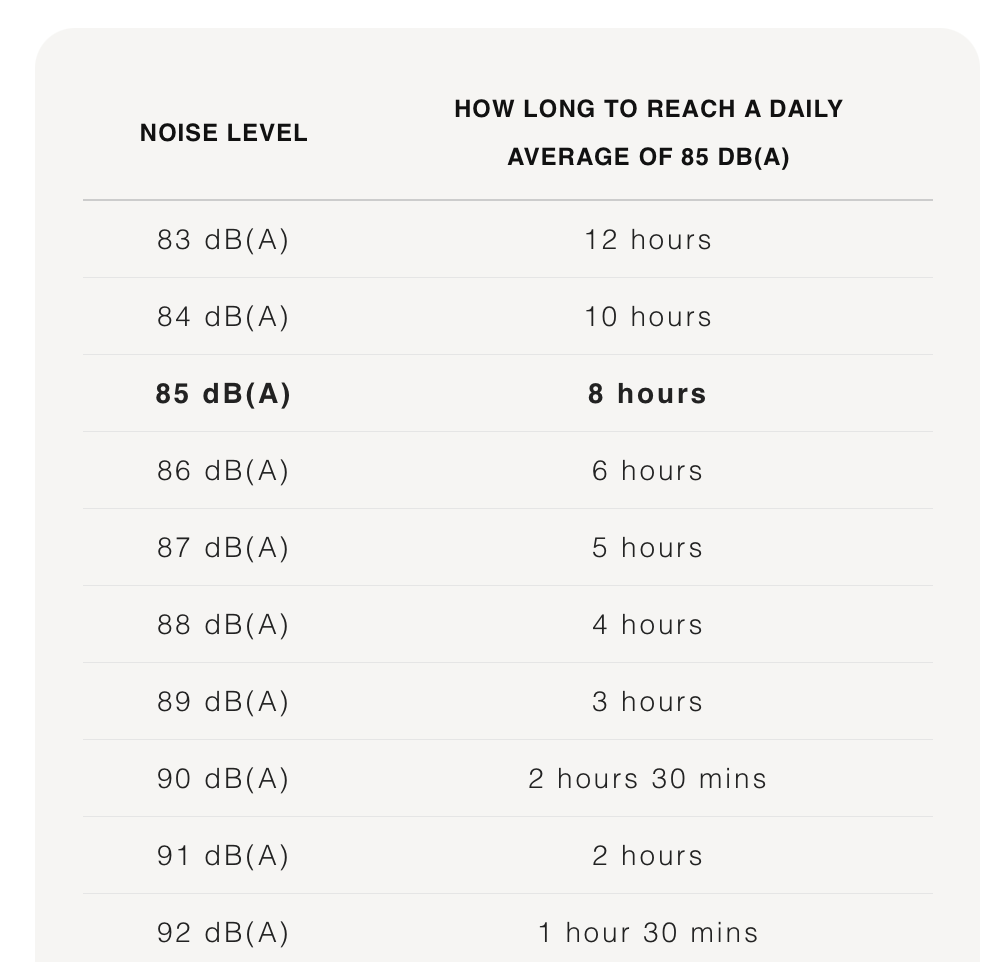
First things first, that 80 dB(A) where a noise assessment is needed is the lower of the two limits, not the higher 85 dB(A) one where things like hearing protection and hearing tests become mandatory.
The HSE have some advice in L108 about how to decide if you need to do a noise risk assessment
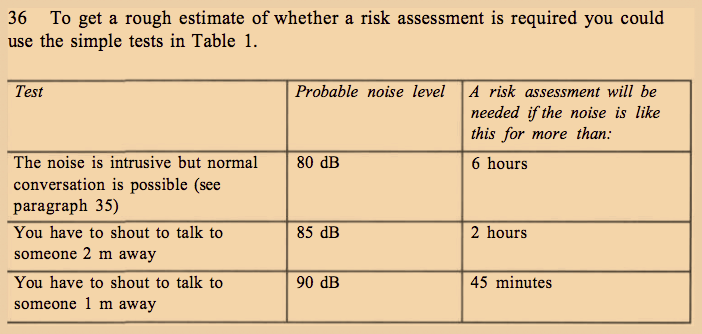
L108: when a noise risk assessment is needed.
Other sources of noise information
There are other sources of information you can use:
Has the manufacturer given any indication of the noise levels in their documentation, either in separate paperwork or via stickers on the machine?
A quick Google can often give you an idea of noise levels for common machinery or tools.
Both these are an indication only and you can’t take them as the actual noise levels for your specific site as that will also be impacted by things like the interaction of other tools and equipment in the room, how the tool is being used, what material it is being used with, etc., but this information can help identify if there may be an issue.
There are some other sources as well which can be a useful indication of a potential noise risk:
Phone apps or an Apple Watch can give an instantaneous reading, but you must treat them not so much as with a pinch of salt, but with a whole bucket-load. Phone apps especially are unreliable for any kind of accuracy, but they can be the noise equivalent of holding a wet finger up to see if it is windy.
The HSE’s comments of whether you can follow speech is a good one - if you have problems hearing people talk while the noise is going on then you probably need a noise assessment.
If people experience that buzzing or ringing in their ears after a job, or things sound muffled, then that is a very strong indication noise levels have been too high.
FAQ: How to decide if you need a noise assessment
You said if a phone app shows noise to be in the high 70s dB(A) then we should get a noise assessment done, but the lower limit where a noise assessment is needed is 80 dB(A). Why did you say ‘high 70s dB(A)’?
That was because phone apps are unreliable as a noise meter, all of them. Sometimes they are out by a couple of decibels, while at other times they can be miles out. If we waited until a phone app said ‘80 dB(A)’ then there is a chance noise levels are already at 85 dB(A) and over. By saying ‘high 70s dB(A)’ I am giving a bit of safety margin to allow for the phone app to be wrong.
Can we just use the manufacturer’s noise data as the noise assessment?
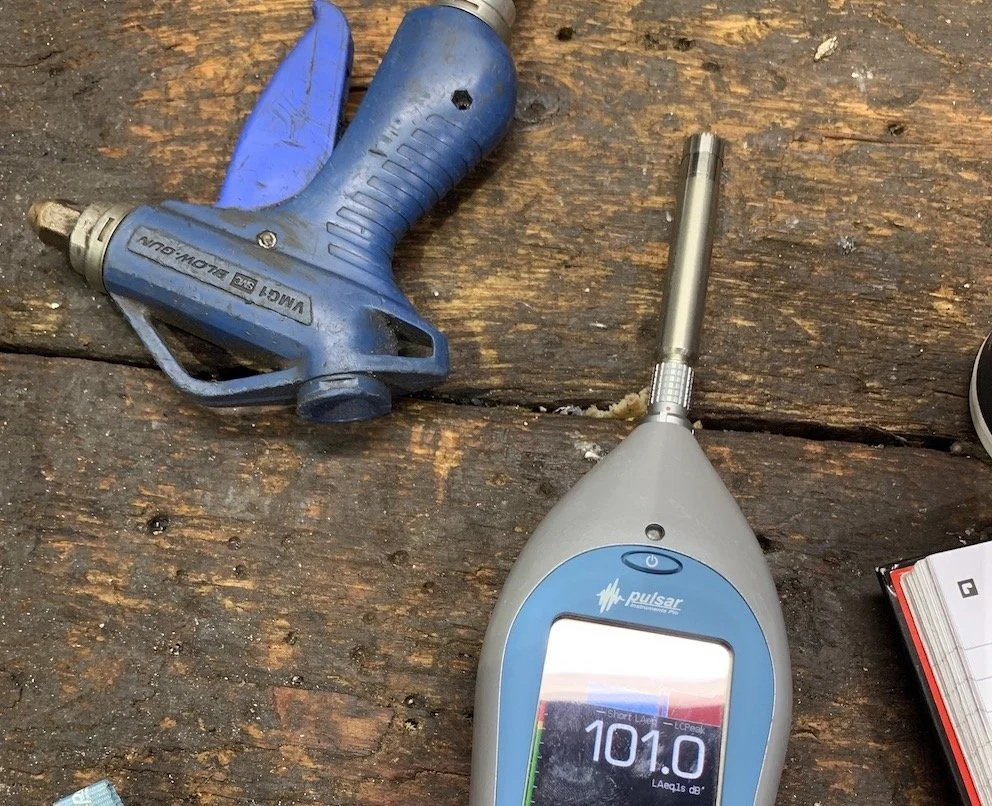
No, for a few reasons. The Control of Noise at Work Regulations 2005 are interested in the noise people receive, not the noise tools or machines make, a subtle but important difference. The manufacture saying a machine makes 100 dB(A) doesn’t mean your staff experience 100 dB(A), it could be less, it could be more. Also, the manufacturer’s data is in an ideal environment while the machine’s placement and usage may cause the noise to vary. Finally, machines and tools age and noise levels change over time.
More help and advice on the noise assessment process