
Noise levels vs exposure time
In a noise assessment, we are looking at not only the noise level but also how long people are exposed to it, and risk is a balance of how loud it is vs exposure time.
Key points: Noise levels vs exposure duration
As noise levels go up, the length of time you can safely be exposed goes down.
As a 3 dB is equivalent to a doubling of the noise risk, for every 3 dB noise goes up, the safe exposure time halves.
Although the main UK noise limit is 85 dB(A), that is actually 85 dB(A) as an average for eight hours.
Someone could be exposed to 91 dB(A), for example, for an hour. If that is their only noise exposure in a day then they will still be below the 85 dB(A) limit as the ‘safe exposure’ time for 91 dB(A) is two hours.
If someone has multiple sources of noise exposures in a day, you can combine them into a single daily average. I have a noise exposure calculator tool to do that which is free to use.
In the Control of Noise at Work Regulations 2005, the main limit people tend to focus on is the one of 85 dB(A). This is actually an average of 85 dB(A) for eight hours, not one instance of meeting or exceeding that.
Exposure time is important in noise risk assessment.
Decibels can be a little odd
Noise is measured in decibels, dB, which can be a little strange as they are a logarithmic scale. What that means practically is that for every 3 dB noise levels go up, the noise risk doubles.
As the main limit is 85 dB(A) for eight hours, that means if you double the noise level then the equivalent exposure time to hit the daily average halves.
So 88 dB(A) for four hours is the same as 88 dB(A) for eight hours, as is 91 dB(A) for two hours, and so on.
The way I can think of explaining the relationship to exposure time is that you can consume noise in ‘bits’ throughout a day. If you have 83 bits of noise in an eight hour working day and go home then you haven’t had the full 85 allowance. If you have 85 bits of noise in four hours though you have now consumed your entire allowance for the day and any more is a problem.
It’s basically the same as chocolate frankly!
Equivalent daily noise levels - noise vs time
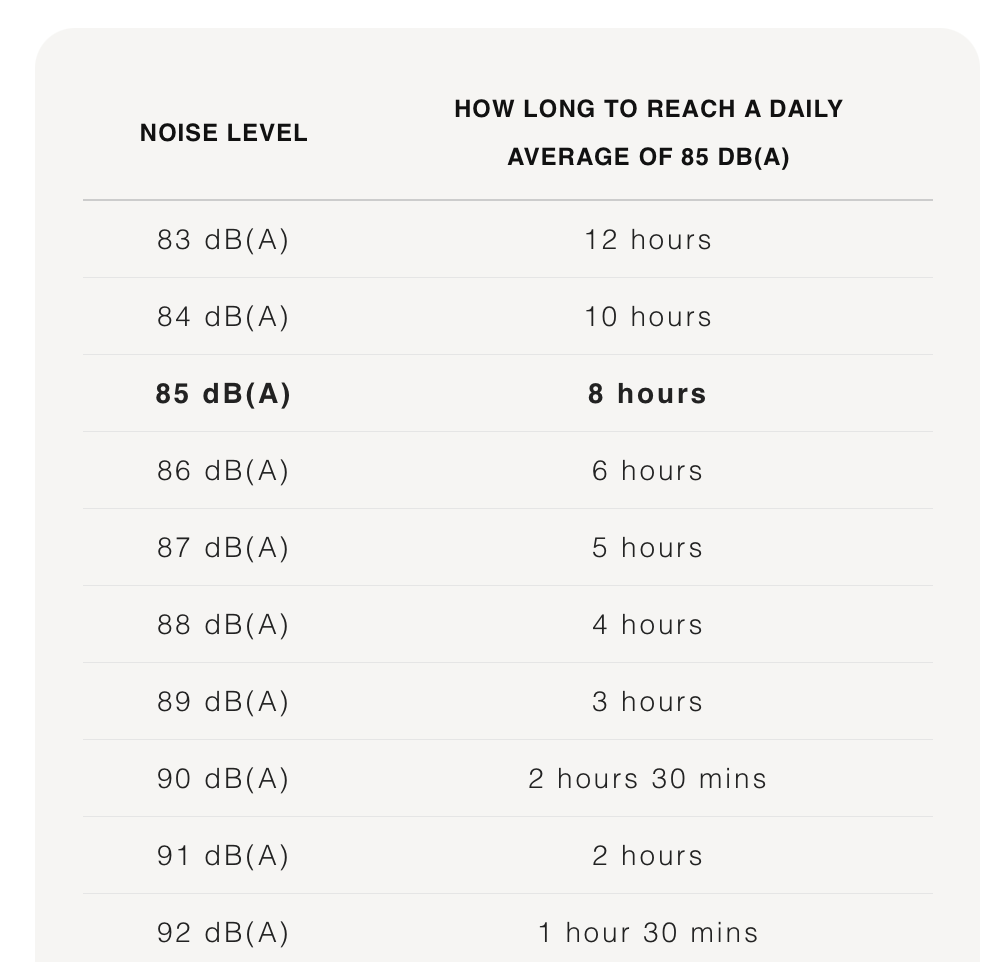
In all the levels in this table, the daily noise dose is the same. 85 dB(A) for eight Horus is the same amount of noise as 88 dB(A) for four hours, and so on.
This table shows how the time taken to reach the noise limit gets shorter with increasing noise level.
| Noise level | How long to reach a daily average of 85 dB(A) |
|---|---|
| 83 dB(A) | 12 hours |
| 84 dB(A) | 10 hours |
| 85 dB(A) | 8 hours |
| 86 dB(A) | 6 hours |
| 87 dB(A) | 5 hours |
| 88 dB(A) | 4 hours |
| 89 dB(A) | 3 hours |
| 90 dB(A) | 2 hours 30 mins |
| 91 dB(A) | 2 hours |
| 92 dB(A) | 1 hour 30 mins |
| 93 dB(A) | 1 hour 15 mins |
| 94 dB(A) | 1 hour |
| 95 dB(A) | 45 mins |
| 96 dB(A) | 35 mins |
| 97 dB(A) | 30 mins |
| 98 dB(A) | 24 mins |
| 99 dB(A) | 19 mins |
| 100 dB(A) | 15 mins |
| 101 dB(A) | 12 mins |
| 102 dB(A) | 9 mins |
| 103 dB(A) | 7.5 mins |
| 104 dB(A) | 6 mins |
| 105 dB(A) | 5 mins |
| 106 dB(A) | 4 mins |
| 107 dB(A) | 3 mins |
| 108 dB(A) | 2.5 mins |
| 109 dB(A) | 2 mins |
| 110 dB(A) | 1.5 mins |
| 111 dB(A) | 1.2 mins |
| 112 dB(A) | 1 min |
| 113 dB(A) | 46 seconds |
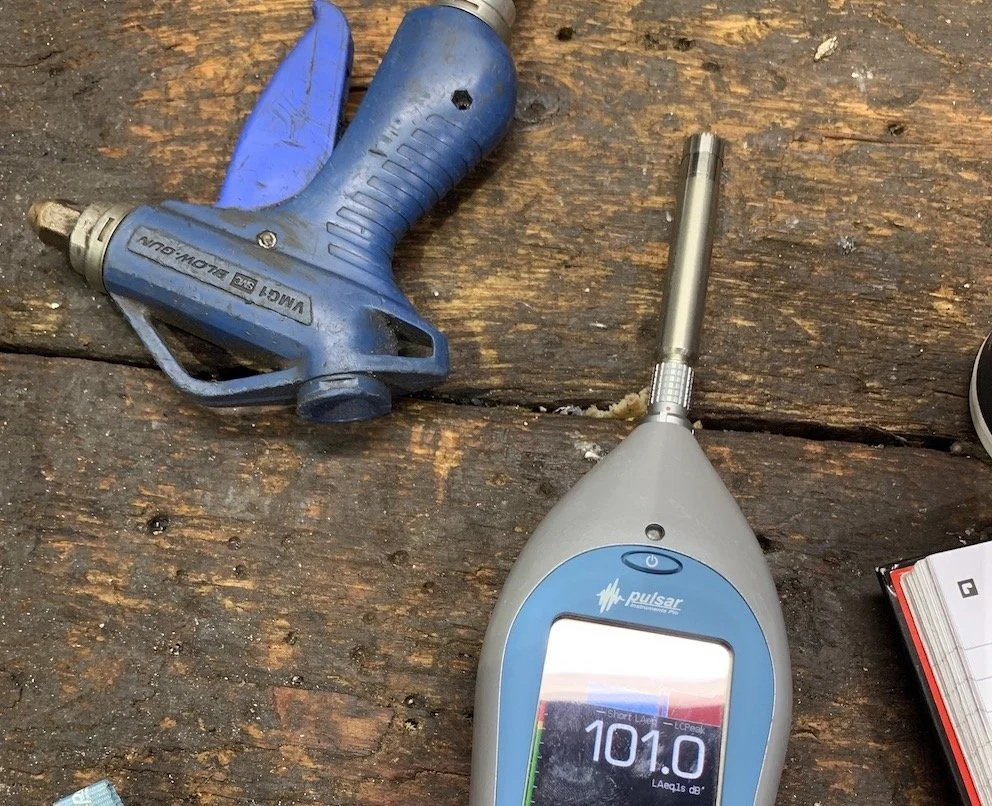
As an example of the practical impact of this. Air guns are a common tool in industry and can reach around 112 dB(A) sometimes. At that noise level, a user will reach their daily noise limit in only one minute of cumulative use through a day, even if no other noise exposures at all.
A note on dB(C) levels
This doesn’t take into account the dB(C) peak exposure limits. Without over-complicating things, dB(C) is another way of measuring noise and with that, exposure time doesn’t matter. It is used for very short term impact noises, quick bangs, to things like dropping a wooden pallet onto a concrete floor.
There is a legal limit for this as well, in this case the limit is 137 dB(C). Any instance of exceeding that is a problem as the power of the noise is enough to damage hearing, especially with repeat exposures.
FAQ: Noise exposures and exposure time
Does hearing protection have to be used for every noise exposure over 85 dB(A)?
The limit, in legal-speak the Upper Exposure Action Value, is 85 dB(A) averaged over eight hours, not a set line of just 85 dB(A). That means the someone may do a job which has peaks of noise over 85 dB(A) within one part of their working routine, but it is the average for their whole routine which is important. A single instance of exceeding 85 dB(A) does not mean hearing protection is automatically needed.
I did my own noise measurements and saw 90 dB(A) as the highest dB(A) seen, should I take that as my noise exposure level?
No, it is common for noise to jump around and what we are interested in is the average for a job. If someone’s job is to get a part, put it on the machine, work it, remove it and store it, and repeat, then for a noise assessment we cover the full cycle. The actual machining element of the job may be louder than the rest but what we are interested in is the average for the cycle, not the highest level seen.
What is the 3dB rule for noise exposure?
Noise is measured in a non-linear way and the outcome of this is that a 3 dB change in the noise level is equivalent to a halving or doubling of the noise energy. That means for every 3 dB louder the noise gets, the safe time halves.
How do I calculate a daily noise exposure from multiple sources?
There is a complicated way to do this involving a lot of maths and the formula for that is in L108: Controlling Noise at Work. Or there is the simple way which is to go to this free noise calculator tool, enter your noise levels and how long someone is exposed for, and it will tell you their daily noise exposure.
More help and advice on noise assessments






Article last updated: June 2026