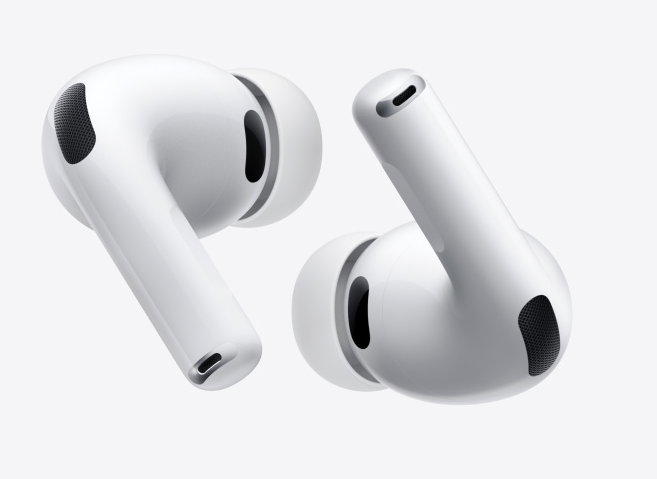

Apple AirPods Pro 3 as hearing protection at work
Apple’s AirPods Pro 3 and their certified hearing protection function are a potential game-changer in terms of what is possible with headphones and hearing protection. This article covers how I myself as a certified workplace noise risk assessor (IoA and NEBOSH Diploma) who works entirely in employee noise safety have found them as hearing protection at work. It is not intended as a review of the Apple AirPods Pro 3 as consumer product generally.
Key points: Apple AirPods Pro 3 as hearing protection
AirPods Pro 3 are certified to EN 352 and carry assigned SNRs. That means they can be used as hearing protection at work in the UK. That is the same standard all hearing protection is certified to in the UK.
AirPods pro 3 are suitable for noise environments of up to 89 dB(A) in Transparency mode, and up to 104 dB(A) in Adaptive and Noise Cancellation modes.
The Conversation Aware feature is excellent in high noise workplaces, letting speech through while maintaining protection.
As a benefit over all other ear plugs, active or passive, the fit test system confirms the fit is good and the right size tip is used for that person.
For use as hearing protection, I would recommend they are always in either Adaptive or Noise Cancelling modes unless the noise risk is only two or three dB over the 85 dB(A) limit.
Employers do not have to permit them though as their use does introduce control obligations for the employer. It is at the employer’s discretion.
I have found them to be excellent as hearing protection, even without playing music - just as stand alone ear plugs.
They are better than other Bluetooth hearing products, but are also a lot more expensive.
AirPods Pro 3: EN 352 and SNR levels
All hearing protection which is used at work in the UK must be certified to EN 352 and carry the appropriate CE / UKCA mark, and as part of that will have an assigned SNR level. SNR is the Single Number Rating, a number of decibels tests have proven they reliably reduce noise levels by. Apple AirPods Pro 3 are certified to EN 352 and do have that all-important SNR data.
Link: Apple AirPods Pro 3 Data Sheet confirming certification.
The SNR level of the AirPods Pro 3 depends on the mode they are in:
| AirPods Pro 3 mode | SNR | Assumed protection | External noise |
|---|---|---|---|
| Passive (noise cancellation off) | 18 dB | 14 dB | Up to 93 dB |
| Transparency mode | 14 dB | 10 dB | Up to 89 dB |
| Adaptive Audio (right slider position) | 15 dB | 11 dB | Up to 90 dB |
| Adaptive Audio (default position) | 26 dB | 22 dB | Up to 101 dB |
| Adaptive Audio (left slider position) | 29 dB | 25 dB | Up to 104 dB |
| Noise Cancellation mode | 29 dB | 25 dB | Up to 104 dB |
SNR figures are as published by Apple, see Data Sheet link.
For non-Apple using people reading this who don’t have AirPods but have shop-floor employees who are wanting to wear AirPods Pro 3 at work:
Transparency mode takes external noise and lets it through so you can hear a lot of what is outside played back inside the AirPod Pro 3. It appears to be focused more on conversational frequencies. You get a lower level of reduction of external noise but the big benefit at work is that you can hear people talking, sometimes more clearly than you can without anything in your ears at all.
Adaptive Audio does a bit of that and a bit of noise cancellation, and the AirPods Pro 3 change how much noise they let through or cancel depending on how loud the outside it, or what type of noise it is. The idea is ‘enough protection but not too isolating’. You can change how sensitive that is with a slider, hence the left, centre and right thing above. It’s good at work as it cuts a lot of external noise out without shutting you away from everything.
Noise Cancellation means the AirPods cuts out as much external noise as possible, continually. No ear plug ever blocks everything, despite some rather optimistic marketing from some online sellers, but the SNR of 29 dB for the AirPods Pro 3 in noise cancellation mode is a strong rating.
Assumed Protection
SNR, which means Single Number Rating, is the certified noise reduction of the AirPods Pro 3 when tested to EN 352, (hence Apple call it ‘EN 352 Protection’ in the settings), while the ‘Assumed Protection’ is what we are allowed to take as the actual real-life noise reduction.
Here in the UK, the HSE say in their regulatory document L108 Controlling Noise at Work that we have to take the SNR and then subtract 4 dB to make allowance for real world incorrect usage, hence the Assumed Protection is always 4 dB lower than the SNR.
Calculating the external noise levels they are suitable for
The table above shows the maximum average noise levels which the various AirPods Pro 3 modes are suitable for. Those figures are based on:
Reducing external noise to 79 dB under the protector, this is the top of the acceptable range given by the HSE and is a comfortable noise level all day.
The calculation is then 79 dB plus the SNR, minus 4 dB.
These are all-day average external noise levels. You can have louder noise levels than this but then for shorter durations. Basically, the louder a noise goes the shorter the ‘safe time’ gets.
Once you are in proper noise cancelling mode, that maximum all-day average of 104 dB(A) is louder than the vast majority of workplaces. Quite a few may have peaks over that but very few average that continually over eight hours.
AirPods Pro 3 also limit playback volume
AirPods Pro 3 EN 352 hearing protection
This is a legitimate concern for employers - will the person using AirPods Pro 3 play music so loud it damages their hearing and we then end up liable for it, or play the music so loud they can’t hear anything else around them such as fire alarms?
Part of Apple’s hearing protection feature ensures that people cannot block out external noise but then play the internal music so loudly it reintroduces its own noise risk, and nor will it block out every external noise. That’s a good thing for hearing protection at work - isolating someone completely is to be avoided.
AirPods Pro 3 in hearing protection mode limit the internal playback volume to 82 dB(A), a good safe level, loud enough to listen to music to but while also meaning external alarms can be heard clearly.
Limiting the internal playback volume is an essential part of that all-important EN 352 certification which lets the AirPods Pro 3 be used as hearing protection at work. The level of noise reduction has to be certified, and the product then has to be proven to not add dangerous noise back in again.
Setting up the AirPods Pro 3 for use as hearing protection at work
There are a couple of steps to go through when doing this but it is simple to follow.
Test the acoustic seal.
This is a test done via the settings to ensure you are getting a good seal around the ear canal. That means the passive noise reduction is effective and the phone does a test to make sure the tips fitted to the AirPods Pro 3 are the right size for that particular person.
This is a big improvement over any other type of hearing protection, even those with in-ear Bluetooth functions. With any other ear plug, or indeed ear muff, you never know if they are fitted properly or not and from experience, in the majority of cases plugs especially are indeed not fitted properly. With the AirPods Pro 3 this test confirms the fit or tells you if one of the smaller or larger tips is needed.
I can’t think of any other type of hearing protector which actually measures whether the fit is good enough or not, a massive win for the AirPods Pro 3 as hearing protection.
Turn on Set Up EN 352 Protection
This is important and it makes the AirPods Pro 3 act as proper hearing protection, including limiting the playback volume to a safe level. This must turned on to use them in the workplace.
How do AirPods Pro 3 perform as hearing protection? My own experience with them.
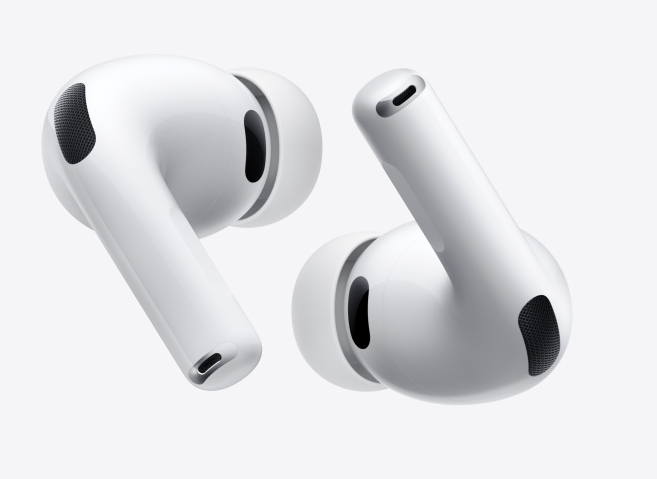
AirPods Pro 3 (image: Apple)
I have now worn them in a few different noise environments including:
Aluminium window manufacture, lots of very loud saws and CNCs.
Vape manufacture, compressed air packing and filling machines.
Printing, some huge printers with constant high noise levels.
Engineering, a lot of welding and grinding bays, CNCs .
Feed mills, noise levels varying from the high 60s through to the high 90s dB(A).
Timber mill, very large barn-sized saws cutting fully grown trees, chainsaws.
Food factory with noise levels varying from the high-70s dB(A) to an average of about 101 dB(A) in some rooms.
Effectiveness at noise reduction in hearing protection mode
A huge advantage the AirPods Pro 3 have over other hearing protection with Bluetooth is that ability to change how much noise reduction you get. Too little noise reduction is a problem at work as your ears are then at risk, but too much noise reduction is also a problem. The HSE call this ‘over protection’ and it does have its own risks - it can mean that the strongest hearing protection on the market can cause an increase in noise risk, not a decrease, and mean people can’t hear other important sounds at work such as alarms, speech or even forklifts driving around.
In a feed mill I trialled wearing them in, some areas had a noise risk which was only a few dB over the limits in some areas so I had the AirPods Pro 3 in Transparency mode. It was enough to take the noise to safe levels but I could still talk to people. When I went to the really high noise areas a quick press on the AirPod stem quietened it all down again - that ability to get the right protection where needed was excellent.
In a big magazine printing factory, some of the noise was in the mid-90s dB as an average so I had the AirPods Pro 3 in Adaptive mode and it was very effective. When I spoke to people the Conversation Aware feature cut in, let me talk and hear them, then switched back to a good level of noise cancelling, superb and a massive improvement on my previous Bluetooth or passive hearing protection.
In the food factory, I was wearing them with no music playing, effectively just using them as ear plugs. Here I tried Adaptive Mode and in the lower noise risk areas they just took a little noise off so were not isolating, but when walking into the loud rooms of the high-90s dB(A) and even just over 100 dB(A), they very quickly automatically upped the noise cancellation and turned the outside noise down perfectly. In addition, when I spoke to staff the conversation aware feature meant I could hold a conversation with no issues.
Being able to tune the noise reduction to the noise risk environment I was in on any particular day proved to be a very significant benefit. It meant I was never isolated and could always balance it between cutting out dangerous noise while still hearing people I was speaking to or hearing vehicles moving around me.
AirPods Pro 3 music playback in hearing protection mode
The music playback was easily loud enough to enjoy while in a high noise area while also remaining at a safe volume to use all day. I had thought that when limited to 82 dB(A) playback levels it would be too quiet but it was absolutely fine. It was loud enough to enjoy but not so loud it blocked out everything else around me.
Music quality-wise, they’re AirPods so are very good indeed. I also have some Sony XM5 overhead headphones and some older Bose ones and the AirPods Pro 3 can hold their own with those. Maybe the Sony are a little better, as they should be with the difference in speaker size, but not by much.
The AirPods music quality is however far better than any other hearing protection with Bluetooth that I’ve tried in the past. I’ve used ISOTunes, Protear, Clas Ohlson, Honeywell and 3M - all were OK, (well, except Protear which were terrible), and the ISOTunes are good when you get a decent fit, but none come close to the AirPods Pro 3 for quality of sound.
Communication and awareness of surroundings in hearing protection mode
This is important for me personally as a chap in his 50s who struggles to follow a conversation in a busy pub and can struggle when trying to hear people speak in a noisy environment. During noise assessments I need to speak to people and ask about their work so being able to hear them is vital.
Before now I had settled on the Loop ear plugs as the best option, and they are indeed good, but the AirPods Pro 3 are a revelation. I can follow what people are saying much more clearly than when wearing them as hearing protection and I have a lot more awareness of what is going on around me.
When I’ve been around vehicles I’ve been able to hear them and never felt entirely cut off.
Yes, the Loop ear plugs are also very good at that, but with those you do need to make sure they are suitable for the noise level you are using them in whereas with the AirPods Pro 3 I can just change the mode to get the right amount of noise reduction. Then again, the Loop ear plugs are £20 and the AirPods Pro 3 are £219 so they damn well should be better!
Employers will need some extra management controls to permit AirPods Pro 3 to be used as hearing protection
There are some management steps an employer would need to put in place if permitting AirPods Pro 3 to be used as hearing protection. An employee may find some of them a little intrusive as it means the employer occasionally checking settings on their personal phone, but if they don’t like it then don’t use AirPods Pro 3 at work, that’s a price that will have to be paid.
Employers will need to check that the headphones / buds in use are indeed actually AirPods Pro 3 and not any of the other Apple AirPods models, or any other brand. People who are wanting to use something other than AirPods Pro 3 will no doubt complain that it is unfair that their product can’t be used but frankly, tough, either the product has EN 352 certification or not and the requirement that only EN 352 certified products can be used is outside of the employer’s control.
Employers will need to ensure the SNR is suitable for the noise risk, bearing in mind the different SNR levels between AirPods Pro 3 modes. That should be checked and detailed in the noise risk assessment.
Employers will need routine ongoing checks to check that the correct mode is being used for the risk. E.g. nobody is using Transparency mode if they are in an area with noise levels over 89 dB(A).
Employers will need routine checks that the hearing protection function is turned on. As it limits playback volume people may be tempted to turn it off.
Employers are not obligated to permit the use of AirPods Pro 3 in high noise areas and could decide that the management steps are too onerous, especially if a lot of staff have other makes or models of headphones than the AirPods Pro 3. Telling one group they can use them but telling all the rest they can’t could cause issues, so whether to allow AirPods Pro 3 will be a decision for each employer to make.
Comparison to other hearing protection with Bluetooth - the ISOTunes range
There are quite a few types of product out there which are hearing protection first and foremost but which also have Bluetooth for music or podcast playback. The ISOTunes range is a good example which covers both plugs and muffs and over the last few years I have bought and used a lot of them in noise assessments. I like them as their playback is good enough quality to listen to all day.
I have compared the AirPods Pro 3 against the ISOTunes Link Aware and Air Defenders, both styles of ear muffs, and the ISO Tunes Pro, ISOTunes Xtra and ISOTunes Free, all of which are ear plug styles.
This is a comparison of AirPods Pro 3 against the three ISOTunes plug options specifically, so plugs vs plugs.
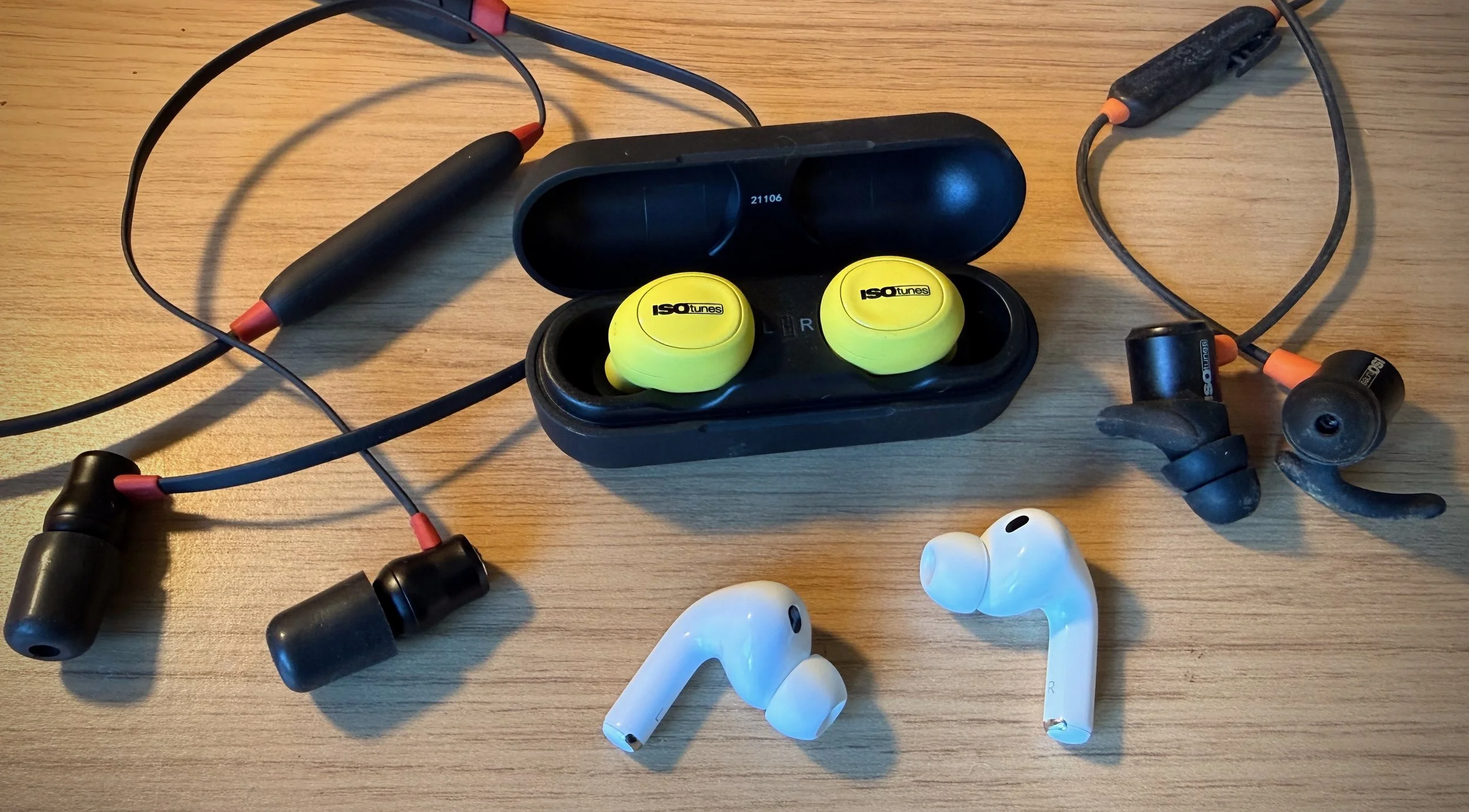
From the left: My ISOTunes Xtra, ISOTunes Free and ISOTunes Pro, to the front Apple AirPods Pro 3
| Feature | Comparison - ISOTunes vs AirPods Pro 3 | Winner |
|---|---|---|
| Noise attenuation | AirPods Pro 3 are 14 dB in Transparency Mode to 29 dB in noise cancellation. ISOTunes are 29 to 36 dB | AirPods Pro 3 Stronger is not better, attenuation needs to be just right and very few places need attenuation into the 30s dB. |
| Communication and awareness | AirPods Pro 3 have conversation aware and automatically adjust sound to let speech through. Base model ISOTunes do not, the 'Aware' level do. | AirPods Pro 3 This is important at work, you need to be able to talk to people without removing hearing protection. The 'aware' models of ISOTunes are bit of a blunt instrument and can get very annoying cutting in and out. |
| Battery life | AirPods Pro 3 managed half a day then were getting low, their case lasts all day though and they recharged quickly in their case on breaks. ISOTunes have all-day battery. | ISOTunes But, the AirPods Pro 3 case charges them back up very quickly, go to the loo or on a break and they are charged up again. |
| Comfort | This is subjective to me, but all three ISOTunes models hurt after quite a short time. AirPods Pro 3 got uncomfortable as well but only after six or so hours of use. | AirPods Pro 3 By a mile to be honest. I've used ISOTunes for a long time now, probably three or four years, and they can be 'challenging' at times in terms of comfort. |
| Music quality | AirPods Pro 3 excellent. ISOTunes can be good but they constantly work a little loose and then bass and volume disappear completely. Push them in tightly to keep the music quality and they get sore very quickly. | AirPods Pro 3 Such a one-sided fight it is unfair really. I've had my ISOTunes for a long time but frequently used other non-Bluetooth ear plugs instead as the balance of soreness vs music quality was never right. |
| Price | AirPods Pro 3 are £219. ISOTunes free are £129.99, ISOTunes Pro Aware are £159.99 and the ISOTunes Xtra are £109.00. All include VAT. | ISOTunes range Clearly a big win for the ISOTunes. But, this is not really comparing like-for-like as people are buying AirPods Pro 3 for use in all aspects of life, not just for use at work. |
All comments are subjective and based on a sample person of one, me, wearing all the products at various times on noise assessments, in a variety of industries.
Apple AirPods Pro 3 vs ISOTunes muffs
For the two ISOTunes muffs I have, the Link Aware and the Air Defender, are AirPods Pro 3 better than those? Again, yes.
The ISOTunes Link Aware I never got on with to be honest. Part-way through a day the band feels like its cutting into my head, and the ‘Aware’ feature which lets quieter sounds through was just rather annoying to listen to and not overly helpful.
The ISOTunes Air Defender was by far the best product ISOTunes made. It was also their cheapest, it was light, it was comfortable to use all day, it was robust, and the music playback was good. You will notice I said ‘was’ there rather than ‘is’, and that is because ISOTunes cancelled the Air Defender in the UK and it is now no longer available from them.
That’s a shame as it was the best product ISOTunes made but it is now off the market in the UK.
Apple AirPods Pro 3 vs ISOTunes summary
AirPod Pro 3 and ISOTunes Free
This is using ISOTunes as the whipping boy purely as I have a good stock of their products and ISOTunes are strong competitor to compare against, but Apple AirPods Pro 3 are a far superior hearing protection product. ISOTunes are better than most other hearing protection with Bluetooth functionality so if AirPods Pro 3 beat ISOTunes then they will beat any others as well.
Apple AirPods Pro 3 are comfier.
Apple AirPods Pro 3 have a more suitable SNR, (noise attenuation), for most workplaces.
Apple AirPods Pro 3 are far better to follow conversations with while wearing.
Apple AirPods Pro 3 have better music quality.
ISOTunes have better battery life, although the AirPods Pro 3 can recharge quickly in their case during breaks.
ISOTunes have a lower price but I would argue that the AirPods Pro 3 are better value.
Summary: The future for hearing protection is arriving
Having tried the AirPods Pro 3 as hearing protection at work, it is absolutely clear to me that the writing is on the wall for all hearing protection manufacturers who make hearing protection with Bluetooth functionality.
History has proven time and time again that where Apple go others quickly follow. It won’t be long before all the standard headphones from Sony, Bose, Samsung, Beats (which are part of Apple so surely will get it soon) etc. have an EN 352 certified hearing protection function built in. When that happens and people have already bought the headphones they like anyway, the need to buy separate hearing protection with Bluetooth goes away if their chosen headphones are already better.
The end of the market for standard ear plugs and ear muffs will be fine, but for those making active noise cancelling hearing protection or hearing protection with Bluetooth, I would think their market is going to disappear very quickly. The AirPods Pro 3 are very much the writing on the wall that this part of the market is about to be radically changed or even vanish completely.
I personally will not be going back to my ISOTunes products after using the AirPods Pro 3, the difference between them is startling. The ISOTunes are back in my cupboard of hearing protection and I doubt will come out again.
Since buying the AirPods Pro 3 to try as hearing protection I haven’t used any other type of hearing protector either, even without playing music, the AirPods Pro 3 are just better in every respect, including fit, comfort, appropriate attenuation levels, lack of isolation and communication.
As I am just me I can choose my own hearing protection and manage it appropriately, but for an employer there are some negatives to consider if choosing to permit AirPods Pro 3 to be used as hearing protection at work as fairly robust management steps do need to be put in place.
More information on hearing protection at work