
Over-protection in hearing protection - why stronger isn’t always safer
Key points: Hearing protection which is ‘over protecting’
The Control of Noise at Work Regulations 2005, and accompanying L108, say employers should avoid proctors which class as over-protecting.
Too much protection often means people cannot hear others speaking so tend to remove the protector to listen, or cannot hear other important noises such as vehicles or alarms. For some, they use how a machine sounds as a guide to its correct functioning and too much protection again incentivises them to remove it.
With hearing protection which is too strong, people tend to not put plugs in fully, or even put them across their ears rather than inside them, or off-set ear muffs to let more noise through, or just spend more time with no hearing protection at all.
Hearing protection needs to be specified in the noise assessment - it should have an appropriate attenuation level for the noise risk on the site.
Stronger hearing protection is not always better.

Too much protection?
When inspecting companies for compliance with the Control of Noise at Work Regulations 2005, the HSE often raise issues with hearing protection being too strong, calling it ‘over protection’
Over-protection often comes from well-meaning employers buying the strongest hearing protection they can find - hearing protection with the highest SNR.
They mean well but it often increases noise risks, and for the employer means more of the money they spend on hearing protection is wasted.
Hearing protection which is too weak causes an increase in risk.
Hearing protection which is spot-on is peak protection.
Hearing protection which is too strong starts to cause an increase in risk again.
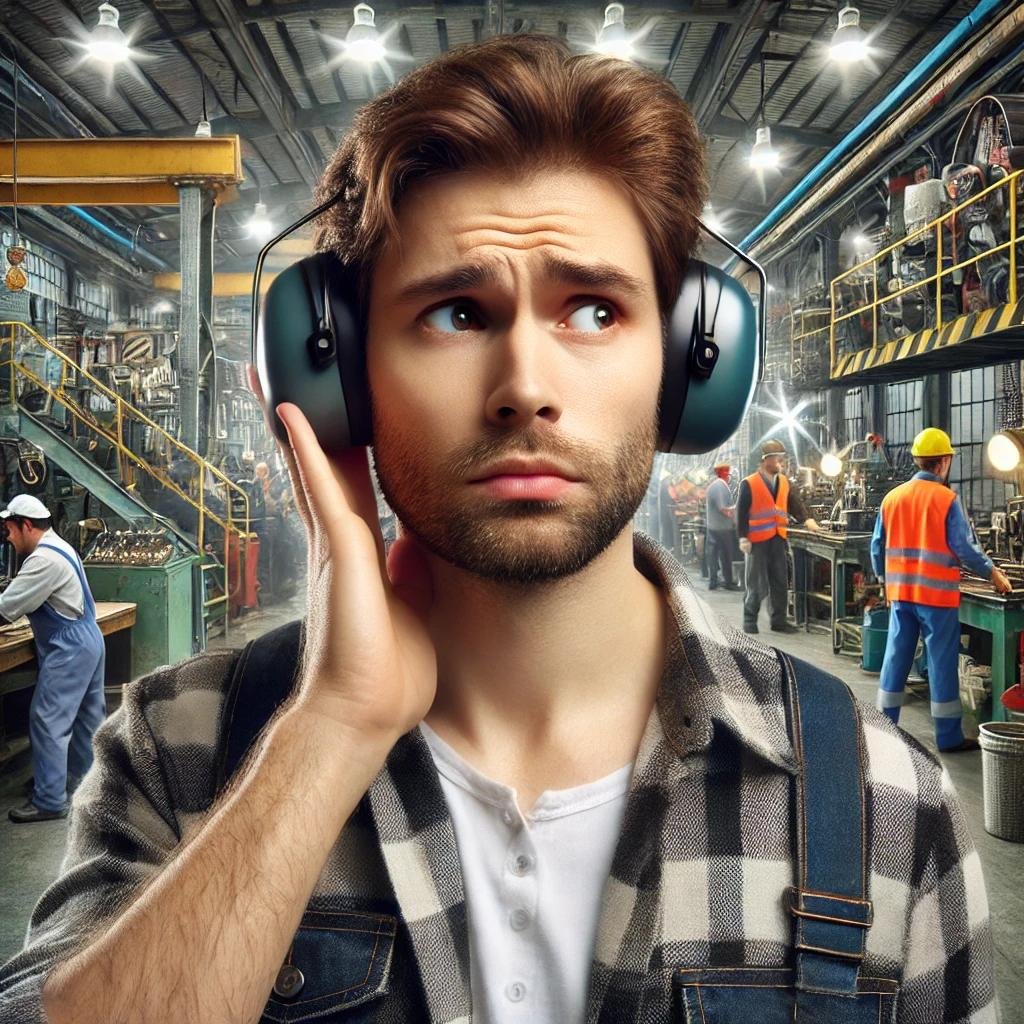
When hearing protection is too strong people often feel isolated and too cut-off from their surroundings at work. They can’t hear vehicles around them which introduces other risks, and they can struggle to ear other people speaking.
Another impact is that importantly for employers, experienced staff will use how machines sound as they operate as a sign that all is as it should be. If they are too isolated they can miss those audio cues of something not working quite as it should, or again they remove the protection so they can hear more clearly.
Almost inevitably, hearing protection which is too strong means people often simply don’t wear it, or if they do they only put it in loosely - ear plugs are sticking out of their ears or ear muffs are slightly off-set and not quite fully on the ears. You see ear plugs held in place by the hairnet in food factories rather than inserted, or ear muffs placed loosely over hoods and hats.
The people themselves are then at risk of noise damage whereas with less powerful protection it can be worn properly and the risk controlled and often they get better protection.
Less powerful hearing protection can actually mean more protection as it is more likely to be worn properly, and other risks such as moving vehicles are minimised.
Giving people ear plugs and telling them to wear them is not enough for the employer to have met all their responsibilities so if the hearing protection is too strong and people then don’t wear it properly the employer can still be liable for any resulting hearing damage.
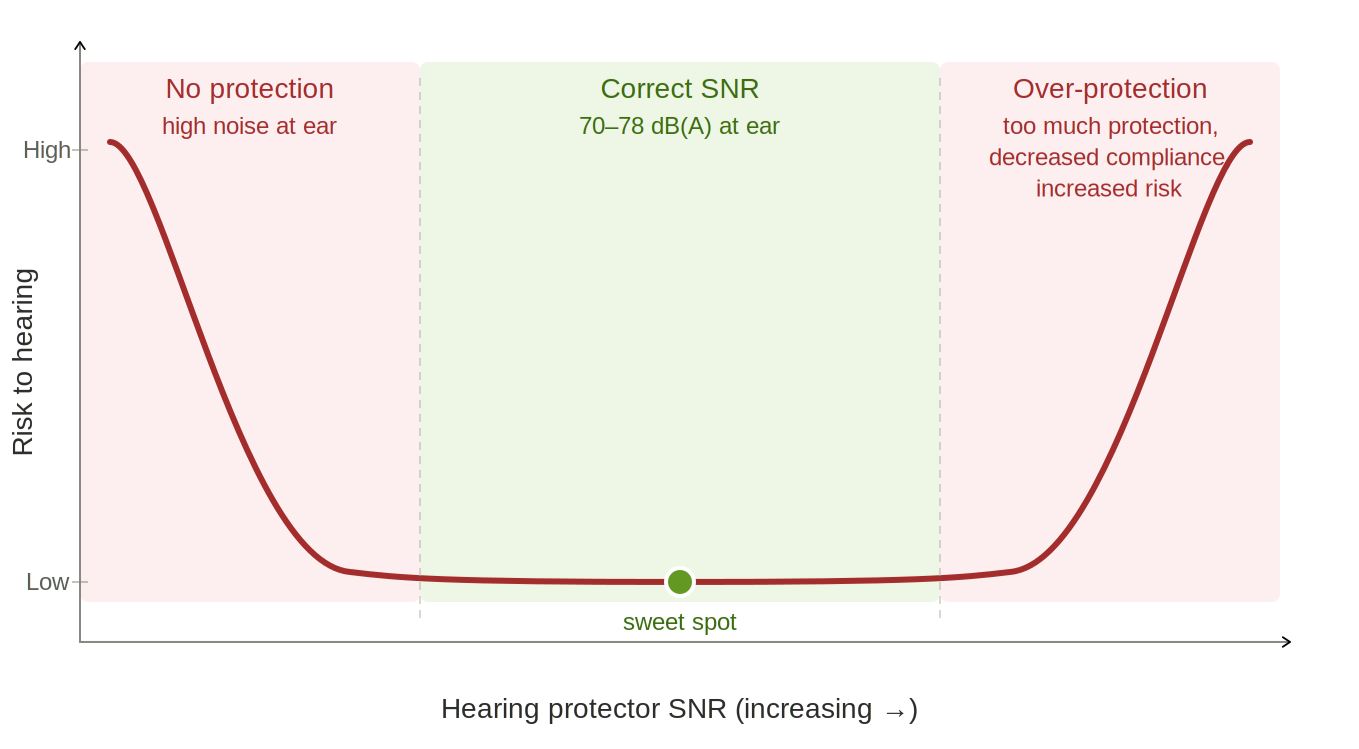
Hearing protection is a bell-curve of safety, too little and too much increase risk.
A real-world example of over protection issues
I did a noise assessment for a large food factory where with the best of intentions they had chosen ear plugs with an SNR of 34 dB, a very high level. (The scale goes from 15 dB at the least-attenuating to 39 dB right at the top end.) They had a few hundred people working on the site and were spending about £20,000 a year on hearing protection.
However, on the noise assessment almost every person had the ear plugs held against their ears by the food-safe hairnet and pretty much nobody had them inserted into the ears. The plugs were doing nothing other than there for show. When I asked people about it the answer was always the same - ‘I can’t hear anybody speaking with them in’.
The employer was spending £20k a year for pretty much no protection and no benefit to either them or the individuals, while still retaining liability for any hearing problems.
The noise assessment showed they actually needed hearing protection with an SNR more around 20 dB. At this level it would take enough off the noise to make it safe but be far less isolating for staff and remove one of the key reasons for non-compliance.
Manufacturers selling based on strongest is best
A lot of online sellers of hearing protection, and especially some of the less well-established manufacturers, market their hearing protection as being strong, or even ‘the strongest on the market’. That ‘strongest is best’ narrative is common to see online.
To non-noise people this seems perfectly reasonable - surely more protection is better than less protection so stronger hearing protection must be the way to go and it is entirely understandable that a lot of employers do head down that path.
In a noise assessment though I measure how loud the noise is and then calculate how effective the hearing protection is for that specific risk, so the employer can be sure the hearing protection is in the Goldilocks zone - not too strong, not too weak, but just right.
Advice on choosing the right hearing protection
There is page on this site going into how to choose the right hearing protection in detail, which includes a free tool where you can enter your noise level and it will list suitable hearing protectors for you by specific name and type.
FAQ: Over-protecting hearing protection
Is it better to err on the side of caution and just get the strongest hearing protection we can?
No, think of it as being that bell curve shown above of how much safety benefit you get. To little protection is a high risk, the right amount of protection is low risk, but then too much protection goes back to a high risk again.
Also, when protection becomes too much, people don’t use it properly, and the employer is then throwing money away.
Should we stop using ear muffs if we need lower attenuating hearing protection?
No, ear muffs come in all strengths, both less-attenuating and strong ones.
Like plugs, ear muffs can be both low attenuating and high attenuating hearing protection, which is why it is important to specify the right protection based on your noise risks.
If we give them strong hearing protection but they don’t use it properly, isn’t it then the individual’s fault if they have hearing damage?
No, because the employer has not provided the correct hearing protection and has contributed to the non-use or incorrect use. In addition, employers have a duty to monitor correct use of hearing protection so simply instructing when to wear it is not enough.
More information on managing hearing protection in the workplace







Article last reviewed and updated: June 2026