
Buying hearing protection - don’t get caught out
Hearing protection can appear simple but it can quickly become a bit of a minefield and it is easy for employers to purchase hearing protection which has questionable status.
Key points:
Listing hearing protection on sites such as Amazon can make hearing protection look better than it is.
It is worth remembering that anyone can list on Amazon as a seller, it is often not Amazon themselves selling it.
Claims of CE or UKCA compliance by placing the labels on a box have little weight if not backed up by the actual performance data.
The same applies to claims of EN 352 certification. That says nothing about which branch of EN 352, nor which revision has been used.
Featuring noise cancellation does not automatically make something hearing protection.
Employers have my sympathy as navigating the world of suitable hearing protection can be hard, with good-looking listings not always leading to the best choice of protection at work.
Things to look out for in hearing protection listings
Hearing protection listings which talk about DIY, gardening, etc but don’t actually mention use in workplace.
Listings which stress an NRR rating. NRR is one measure of how many decibels the protector reduces noise by, but importantly it is not the same as the SNR system used here in the UK, is not calculated in the same way, and has no relevance in the UK.
Listings which claim an SNR figure but there is no further performance information such as HML or APV values, nor a clear statement on EN 352 certification.
Listings saying ‘EN 352 certified’ but not specifying what branch of EN 352 it is, or which revision. There are a lot online saying ‘EN 352:2002’ but that was superseded in 2020 and has not applied for quite some time now.
Anything using phrases such as ‘total noise isolation’, ‘blocks all noise’ etc. No hearing protection anywhere can do that, it simply doesn’t exist. If a sales listing is using that kind of nonsense hyperbole then it raises questions about everything else they claim.
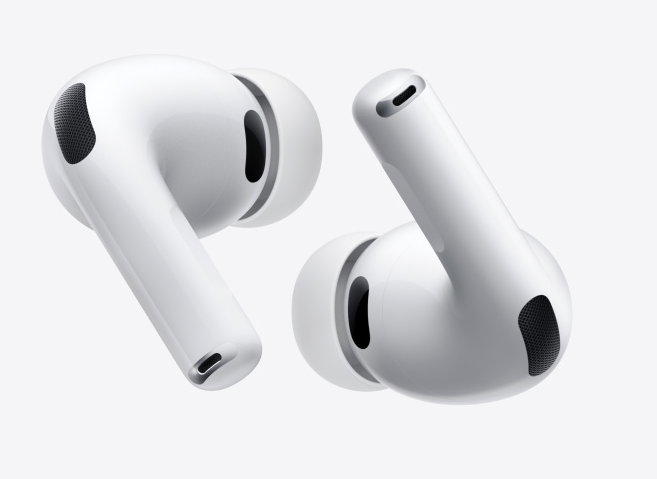
Noise cancelling does not automatically make them classed as hearing protection at work. At the time of writing, the only standard headphones which are also classed as hearing protection are Apple’s AirPods Pro 3.
Useful to know: SNR, HML, APV and EN 352.
You will see these referenced here. HML and APV are ways of assessing the performance of hearing protection and are a mandatory part of EN 352 certification. You will probably not use HML or APV, but it should be there and is a sign of properly certified protection.
SNR: Single number rating. A single figure of how many decibels the protection reduces noise by. The simplest means of measuring it.
HML: Three figures for how much the hearing protection reduces noise by, grouped into High, Medium and Low frequency bands.
APV: A table of complicated-looking numbers of how many decibels a hearing protector reduces noise by at quite a range of frequencies.
EN 352: The standard for assessing hearing protection performance. Hearing protection must be assessed to this. It has a few branches depending whether muffs, plugs, etc, and has been revised over the years. The current revision is EN 352 2020 and any protection sold should be to that, not the 2002 or 1993 revisions.
Case studies
These are some of the hearing protection I come across about which I have concerns regarding their use in the workplace.
Case Study: Doohoeek Wireless Hearing Protection
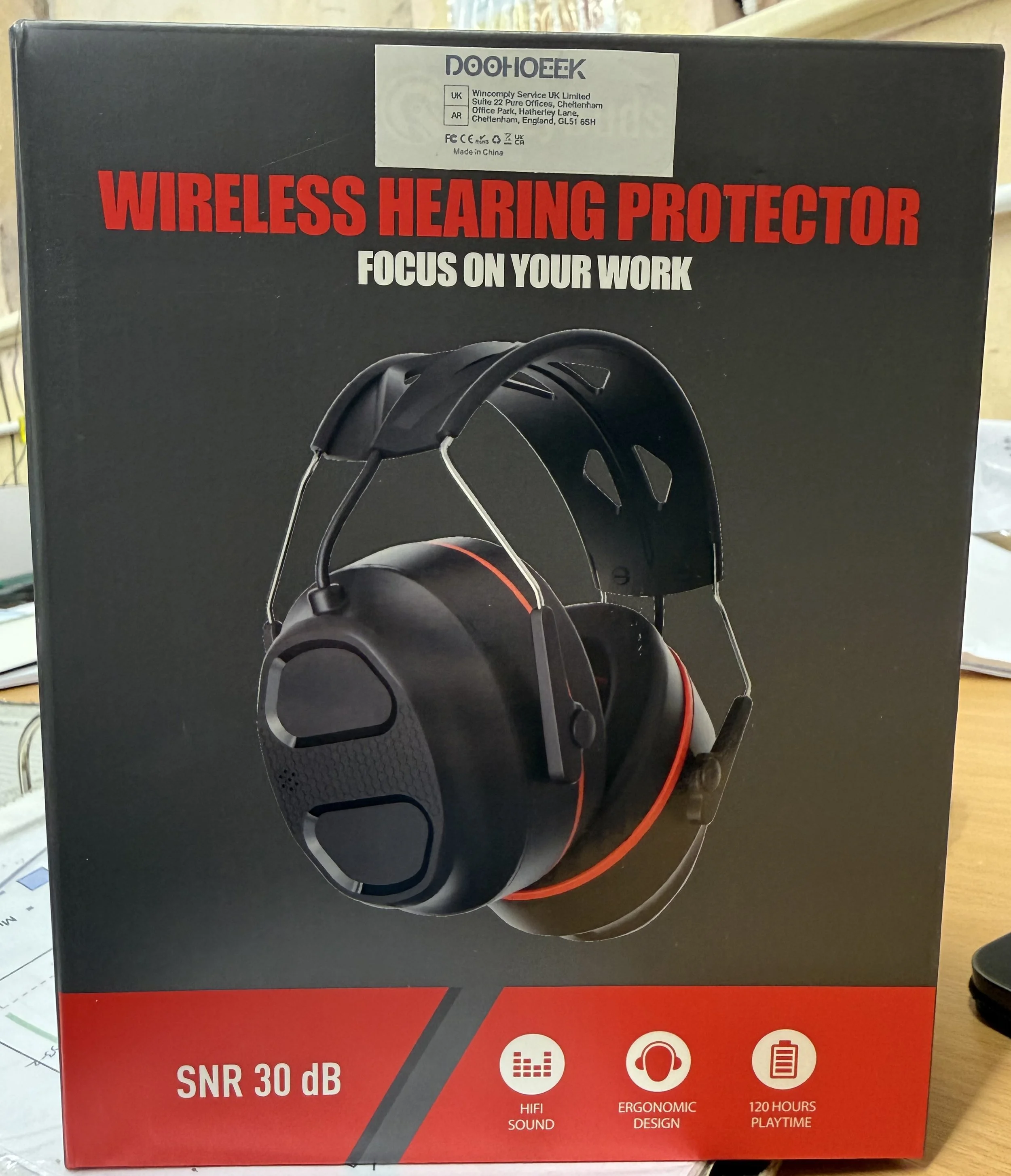
These Doohoeek product are ear muffs with Bluetooth functionality, meaning someone can listen to music or podcasts while wearing the hearing protection. The packaging looks great and their online listings have all the right words, but there are several red flags which come up when you look more deeply at them.
Doohoeek protectors appear to be available via eBay and Amazon. Products which are not available via reputable PPE suppliers and are only on those two sites, where anyone can list anything for sale, can be questionable. Listing there is not automatically a guarantee of a suitable product.
Neither the packaging nor the user instructions leaflet inside give any HML or APV performance information – both those are the more detailed assessment of noise attenuation levels. Doohoeek have a stated SNR but SNR is the most basic of noise attenuation information possible. Anything certified to EN 352 should also have HML and APV data as it is derived from the same certification so the lack of this is another warning sign.
The Doohoeek user instructions show a CE mark and the box has both CE and UKCA labels, but neither the instructions or box make any mention of EN 352 certification, importantly to which branch or revision of EN 352 they have been certified to. Anyone can print CE or UKCA on a box but without a conformity certificate then it has to be seen as potentially unreliable.
The Doohoeek online listing gives the same 30 dB attenuation rating for both SNR and NRR. NRR is used in the USA in a similar way to how SNR is used here, but NRR and SNR are not the same – they are calculated differently and I have never seen a product before which claims exactly the same value for both, another warning sign.
I would not recommend these are used in the workplace.
Case study: Procase Ear Defenders
The Procase muffs are mostly an Amazon / eBay product and there are some red flags which come up with them.
For example, their own Procase user manual contains “If the fit feels too tight initially, you may gently stretch the headband. This can be achieved by placing the earmuffs over a box or similar object for 1-2 days. This process helps to slightly loosen the headband for improved comfort without compromising the noise reduction performance.”
Part of the EN 352 certification for hearing protection is based on the tightness of the headband – that ‘squeeze’ is a critical part of their function and deliberately lessening this introduces a huge unknown into how effective the remaining protection is. Altering the tension of a headband is directly contrary to how ear muffs should be used. The fact Procase specifically raise this gives very particular concerns regarding their use at work.
As another issue, Procase themselves are not consistent about the SNR, with it being quoted in various places as 32 dB or 33 dB.
On Amazon, Procase push them as specifically to help with autism but frankly that is just marketing as all ear muffs are just as good for reducing sensory inputs. They are decent enough for that but there are other issues regarding their use at work which give too much cause for concern. Being useful for autism (although no more so than any other product) does not automatically make them so for work.
Case study: Screwfix Site SEP10 Ear Plugs
Screwfix are very good at what they do, but what they do is not manufacturing hearing protection.
Their listing for the Site SEP10 includes a stated SNR figure on the listing, but there is no other performance data available. I contacted Screwfix Customer Services to ask for more information on the performance levels but they were, to be honest, clueless and not remotely helpful. They hadn’t got the faintest idea of what they are selling.
Given the number of good hearing protectors on the market which do make all the performance data available you may as well avoid the ones who do not.
Summary
Keep to these guides and it will help you get good products
If it is only for sale on Amazon and/or eBay and not via reputable PPE suppliers, it is best avoided.
If it states an SNR but gives nothing else about HML or APV avoid.
If it says a bland ‘EN 352’ but doesn’t state which branch or revision, avoid.
If it says EN 352: 2002, or 1993, definitely avoid.
If it gives an NRR figure but no SNR, definitely do not buy it.
If it is listed on my page of hearing protectors then go for it. (I do not get kickbacks, there are no links to buy so no way for a retailer to know you saw it there).
FAQ: Problematic hearing protection
I want to use my own hearing protection at work, if I buy it then what is the problem, surely that is now my issue, not my employer’s?
Employers have a legal duty to ensure hearing protection is suitable for the noise risk in the workplace. There is nothing stopping someone providing their own but it still has to be suitable for the noise and workplace, and employers are responsible for checking that. They cannot permit hearing protection to be used which may be giving concerns no matter who buys it.
I want to use a specific ear muff because noise causes me stress and Procase are good for that, why can’t I wear them at work?
The Procase muffs are indeed good for reducing sensory input for people who may struggle with that, but no more so than any other ear muff. Procase have just decided that prioritising people who want to reduce sensory input is a good marketing route, not because the ear muffs do anything different to any other.
More help and advice on hearing protection at work









Article last updated: September 2026